How to Design a Small Masculine Living Room
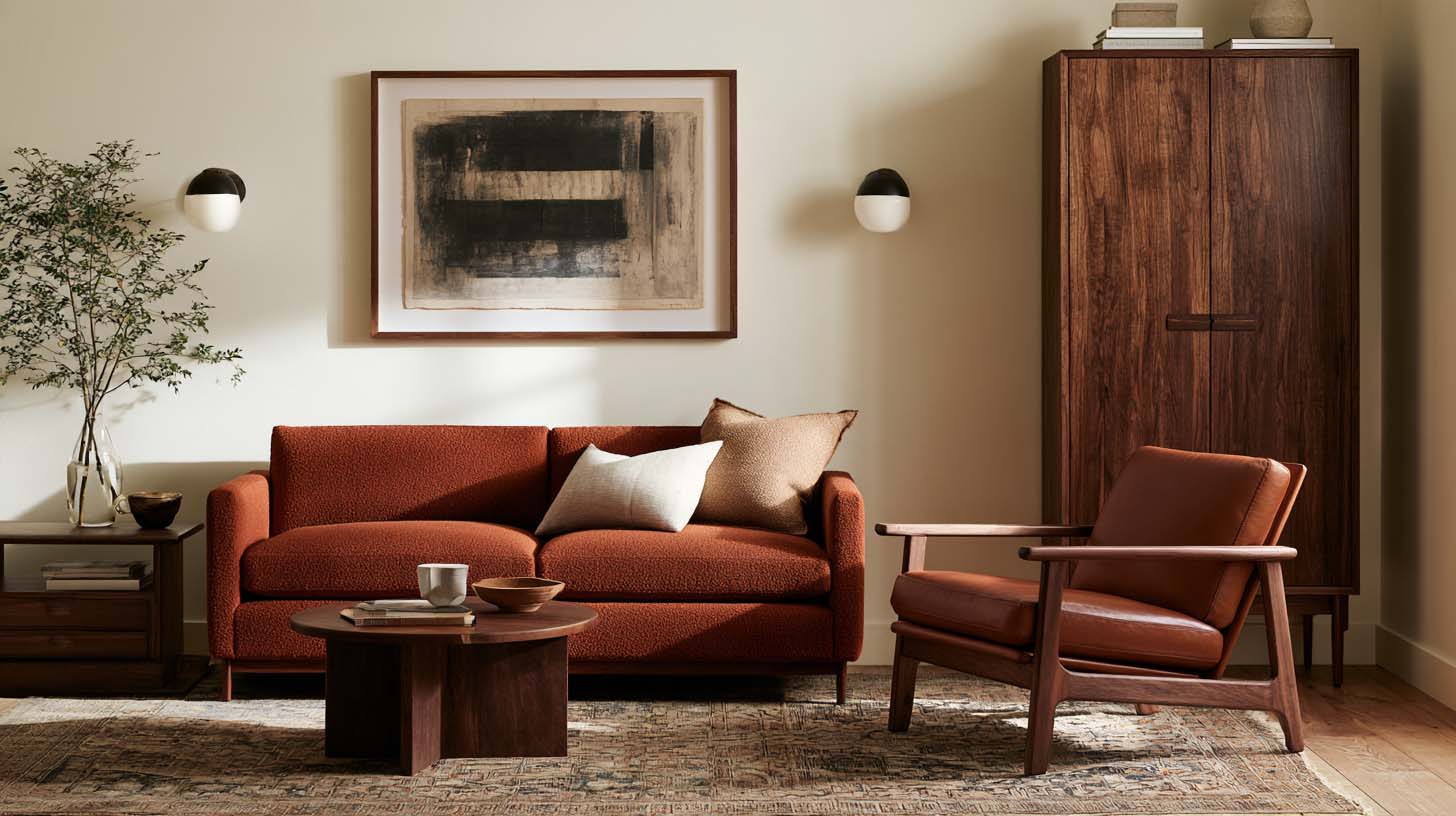
There is a piece of advice given constantly to people furnishing small rooms:
Buy small furniture.
It sounds logical.
Unfortunately, it can produce a small masculine living room filled with so many undersized pieces that the room begins looking more cramped, not less.
Tiny sofa.
Tiny chair.
Tiny coffee table.
Tiny rug.
Several little storage units squeezed around the perimeter.
Nothing has enough visual authority to anchor the room, yet the sheer number of objects makes every square foot feel occupied.
A better approach is usually fewer, more substantial pieces chosen carefully for their actual dimensions.
A small room does not need miniature furniture.
It needs disciplined furniture. If you are not sure whether your own living room has too many small pieces or too few strong ones, a Room Audit is a fast way to get an outside opinion.
Begin With What the Living Room Must Actually Do
Before buying anything, define the room's jobs.
Perhaps you need to watch television, entertain four people, read, listen to music, work occasionally, store books, display art, keep children's items out of sight, or accommodate an overnight guest.
You may not be able to maximize every function.
That is useful information.
A 120-square-foot living room designed primarily for conversation should look different from one where a large television is used every night.
Trying to make the room equally good at eight unrelated things usually creates eight pieces of furniture competing for space.
Decide what matters.
Small Living Room Ideas for Men Should Start With the Sofa
The sofa is generally the largest object.
Get it right first.
Do not automatically buy an apartment sofa because the room is small.
Measure.
A 78-inch sofa with proper seat depth may fit beautifully where an 88-inch version will not.
But replacing that 78-inch sofa with a 62-inch loveseat plus two extra chairs may actually consume more usable floor area.
Look at the whole seating plan.
Arm width matters too.
A sofa with enormous rolled arms may sacrifice significant seating width.
A cleaner track arm can provide more usable seat within the same overall dimensions.
Leg profile matters visually.
Exposed legs reveal floor and may make the piece feel lighter.
A sofa reaching directly to the floor can feel more grounded.
Neither is inherently better.
Choose according to what the room needs.
Do Not Push Everything Against the Walls Automatically
Small rooms often produce a defensive furniture layout.
Everything gets shoved outward.
Sofa against one wall.
Television against another.
Chair wedged into a corner.
Empty space in the center.
Sometimes that is correct.
Sometimes moving the sofa a few inches from the wall and angling or floating a chair slightly creates a much more intentional composition.
Furniture needs relationships more than it needs maximum distance from the center.
A room that feels socially coherent often feels larger because the arrangement makes sense.
Use One Proper Chair Instead of Two Weak Ones
If the room only comfortably accommodates one additional chair, buy one good chair.
Do not force symmetry with two undersized chairs.
A substantial reading chair can become a focal point.
Perhaps it is cognac leather, olive wool, rust velvet, or a patterned tweed.
The asymmetry can actually make a small room more interesting.
This is a useful general rule: Do not reduce the quality of every piece simply to increase the quantity of furniture.
Rug Size Can Make a Small Room Feel Smaller
A small rug creates a small visual territory.
Then the furniture sits partly or entirely outside it.
The eye reads several disconnected zones instead of one room.
A properly scaled rug can often make a small living room feel more generous because it unifies the major furniture.
This does not mean the rug should touch every wall.
It means it should relate convincingly to the seating group.
Before buying, mark the dimensions on the floor with painter's tape.
Then place the furniture around those dimensions.
The difference between imagining 6-by-9 and actually seeing 6-by-9 on your floor can be substantial.
Large Pattern Is Not Forbidden
Small room advice often becomes a list of prohibitions.
No dark color. No pattern. No large furniture. No substantial art. No heavy curtains.
The result can be a small room that is also timid.
A large patterned rug may actually create stronger visual continuity than a small-scale busy pattern.
One large painting can be calmer than six little frames.
A strong plaid chair may create more character than several patterned accessories.
The room is already small.
You do not need to disguise that fact.
You need to make the small room feel intentional.
Use Vertical Space
Small living rooms frequently have unused real estate above eye level.
Bookshelves, tall cabinetry, artwork, curtains mounted appropriately to the architecture, wall sconces, and picture lights all draw the eye upward and allow storage or visual interest to occupy the wall rather than the floor.
A tall bookcase may consume the same footprint as a low cabinet while storing considerably more.
Built-ins can be even more effective because they turn storage into architecture.
Designer Eyes: Count the Furniture Footprints
Stand in the doorway and count how many separate objects touch the floor. Sofa. Two chairs. Coffee table. Two side tables. Media cabinet. Floor lamp. Bookcase. Plant stand. Ottoman. That is ten footprints before the room even begins. Sometimes the best small-room edit is not buying a smaller version. It is removing an entire category. Could the floor lamp become a sconce? Could one side table serve two seats? Could an ottoman replace both coffee table and footrest? Fewer footprints make a remarkable difference.
Storage Should Do More Than Store
A small masculine living room benefits enormously from furniture with more than one job.
A media cabinet can hold games, cables, books, and household clutter.
An ottoman may provide storage and occasional seating.
A console behind a sofa can provide lamps, display, and drawers.
Built-in shelves can incorporate television, books, objects, and closed cabinets.
A side table with a drawer is more useful than a sculptural pedestal if storage is scarce.
This does not mean every object needs a secret compartment.
It means limited square footage should not be spent casually.
Closed Storage Is Particularly Valuable
Open shelves are attractive when the contents deserve visibility.
They are less useful for cables, controllers, paperwork, chargers, children's toys, spare blankets, and household supplies.
If a small room has no concealed storage, ordinary life quickly becomes decoration.
A mixture of open and closed storage usually works better.
Books and objects remain visible. Visual noise disappears behind doors.
Do Not Use the Coffee Table by Habit
Does the room need one? Maybe.
But a coffee table occupies prime floor area.
In a very small room, alternatives may work better: a smaller substantial table, a large ottoman, a pair of nesting tables, side tables, or a compact round table that improves circulation.
The question is not what a living room is supposed to contain.
It is what this room needs.
Round Furniture Can Improve Circulation
Corners matter in tight rooms.
A round side table beside a sofa can be easier to move around than a square one.
A round coffee table may improve circulation between seating pieces.
A rounded chair can soften a room dominated by rectangular architecture.
This is not a rule that small rooms should contain curves.
It is simply recognition that circulation happens around furniture.
A missing corner can sometimes be useful.
Lighting Should Not Consume All the Floor Space
Small rooms need layered lighting just as much as large ones.
But three floor lamps may be too much.
Consider wall sconces, plug-in sconces where appropriate, table lamps, picture lights, a good ceiling fixture, and integrated shelf lighting.
Ambient, task, and accent lighting solve different visual needs. A small room can still use all three; they simply do not need to come from three floor-standing fixtures.
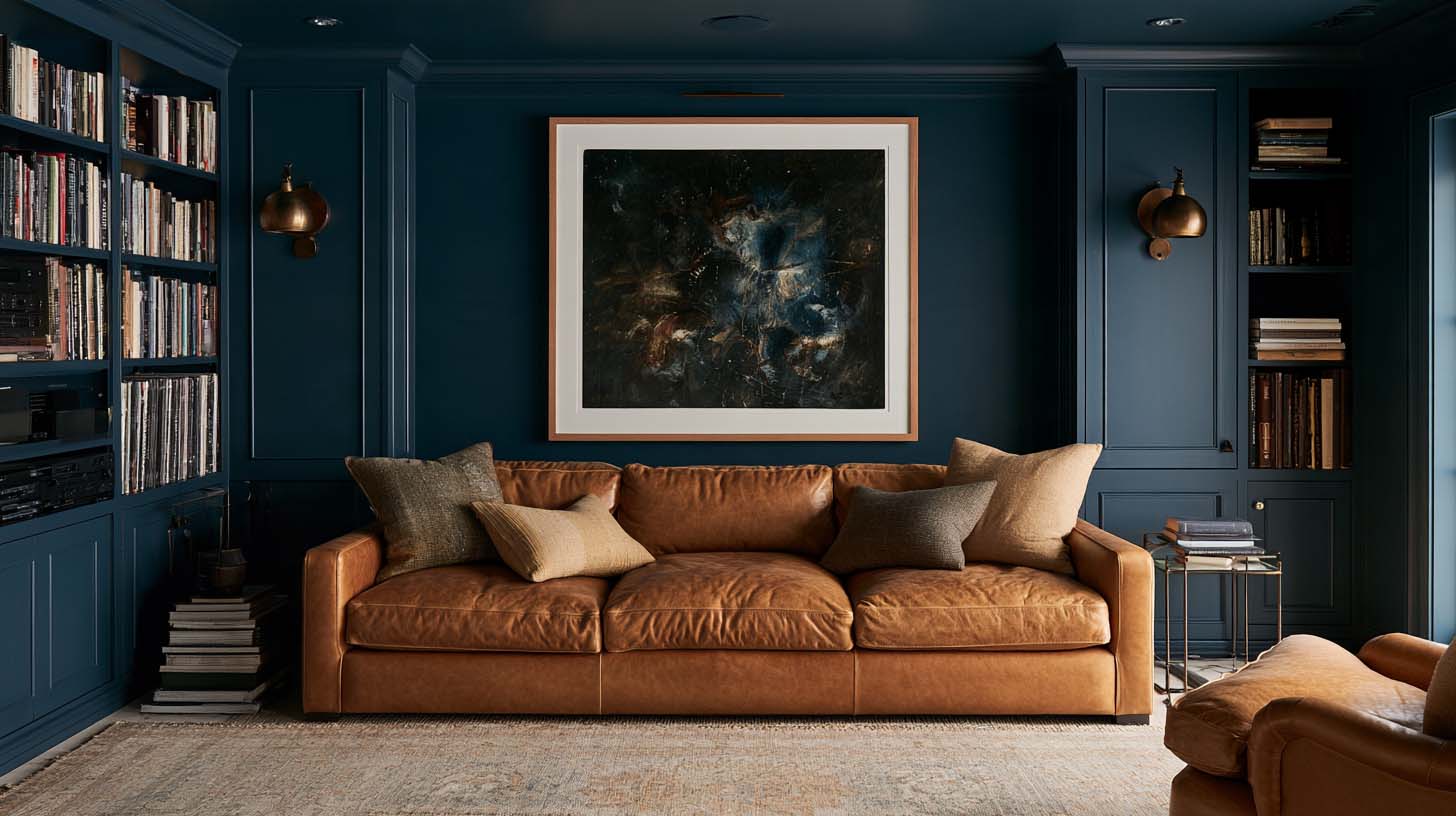
Dark Paint Can Work in a Small Masculine Living Room
Small does not mean white.
A small room can be olive, deep blue, tobacco, blackened green, warm brown, charcoal, or slate.
The decision depends on light, architecture, furniture, and the atmosphere you want.
Dark color may reduce reflected light, but that does not automatically make the room unsuccessful.
In some small rooms, embracing enclosure creates a far stronger result than trying to make the walls visually disappear.
The important thing is balance.
Dark walls with a dark sofa, dark rug, dark curtains, dark cabinetry, and poor lighting may become heavy.
Dark walls with cream upholstery, warm wood, art, good lamps, and a lighter rug can feel enveloping rather than oppressive.
Light Rooms Still Need Weight
The opposite mistake is assuming pale colors solve everything.
Warm ivory walls. Cream sofa. Light oak. Beige rug. White curtains.
The room may feel larger but also anonymous.
Introduce one or two stronger anchors. Walnut table. Oxblood chair. Dark artwork. Bronze lighting. Deep-blue rug.
Masculinity does not depend on darkness, but the room usually benefits from enough contrast to create structure.
Use Mirrors for a Reason
Mirrors can reflect light and views. That can be useful.
But a mirror should reflect something worth seeing.
Place one opposite a blank wall and you have simply created a second blank wall.
Place it where it catches a window, artwork, shelving, or a good portion of the room and it begins contributing.
The frame also matters. Wood, bronze, painted timber, or restrained metal can make the mirror feel like a deliberate object rather than a space-expansion trick.
Curtains Can Make the Room Feel More Finished
Small rooms are often denied curtains because fabric is assumed to consume visual space.
Yet bare windows can make a room feel temporary.
Proper curtains add verticality, softness, acoustic absorption, and a finished edge around the architecture.
Choose the material and fullness carefully. Linen can keep things relaxed. Wool can add weight. A subtle stripe may create vertical movement.
The window treatment should belong to the room rather than being omitted solely because the floor plan is small.
Large Art Often Works Better Than Many Small Pieces
One substantial piece of art gives the eye somewhere to stop.
A cluster of twelve small frames introduces twelve edges, twelve images, and many gaps.
Gallery walls can absolutely work in small rooms, especially when the collection has meaning.
But do not assume small room equals small art.
A large painting above the sofa may actually make the wall feel broader and the furniture more substantial.
Keep the Palette Restrained, Not Colorless
Small rooms benefit from relationships that are easy to understand.
That might mean olive plus walnut plus cream plus rust, or deep blue plus medium oak plus tobacco plus warm ivory, or charcoal plus camel plus oxblood plus bronze, or taupe plus espresso plus muted blue plus stone.
You can still have color.
The restraint comes from limiting the number of major color families and repeating them subtly.
A room with seven unrelated neutrals can feel more chaotic than a room with three actual colors.
Furniture Legs Change Perceived Weight
Furniture lifted on visible legs reveals more floor. That can make a room feel visually lighter.
Mid-century furniture often uses this particularly well.
But not every piece needs exposed legs.
A grounded sofa combined with leggy side tables can create useful contrast.
A substantial cabinet may look better reaching the floor while chairs remain visually lighter.
Again, the goal is not maximum airiness. It is balanced weight.
Make the Television Belong
A large black rectangle can dominate a small living room very easily.
Think about the wall around it.
Could cabinetry integrate it? Could dark paint reduce the contrast? Could books or art nearby keep the television from becoming the only focal point? Could the seating orientation allow attention to move elsewhere when the screen is off?
Trying to hide the television completely is not always necessary.
But allowing it to define the room by default usually is.
Small Rooms Benefit From Better Objects, Not More Objects
A small room puts everything closer to the viewer.
That means quality becomes noticeable.
One good lamp. One substantial ceramic. A real piece of art. Several meaningful books. A well-made tray. A collected object.
These carry more authority than fifteen little accessories.
The limited surface area is an advantage. It forces editing.
Do Not Fill Every Corner
An empty corner is not necessarily a problem waiting for a plant stand.
Negative space allows the furniture to remain legible.
This matters particularly in small rooms where every object is close to another.
A little emptiness can make the room feel more generous than another side table ever will.
Designer Eyes: Photograph From the Doorway
We frequently find that a small room reveals its problems more clearly in a photograph than while standing inside it. Take one image from the entrance. What overlaps? Which object looks too small? Where does the eye stop? Is there a clear seating composition or simply furniture around walls? The camera flattens the room enough to expose clutter and weak hierarchy. Use that to edit.
The TMH Perspective
A small masculine living room does not need to apologize for being small.
In our design work, the stronger small rooms usually emerge after we stop trying to preserve as much empty floor as possible and instead decide which pieces deserve the limited space.
One proper sofa. One good chair. A rug large enough to connect them. Storage that actually stores something. Lighting at several heights. Art with enough scale.
Perhaps that is all the room needs.
Small spaces become convincing when every object earns its footprint.
If your living room feels crowded but you cannot tell whether the problem is furniture size, layout, rug scale, storage, or simply too many pieces, TMH's Full-Service Interior Design can plan the room as a whole: what should stay, what should move, and what the space genuinely needs to work.
Frequently Asked Questions
How do you make a small living room look masculine?
Use substantial furniture in appropriate dimensions, a restrained but not necessarily dark palette, real materials, properly scaled art and rugs, layered lighting, and controlled storage.
Should you use small furniture in a small living room?
Not automatically. Fewer appropriately scaled pieces often make the room feel larger and more resolved than many miniature pieces.
Can you paint a small masculine living room dark?
Yes. Deep blue, olive, charcoal, brown, and blackened green can work beautifully when balanced with lighter materials, adequate lighting, and intentional contrast.
What size rug should you use in a small living room?
Use a rug large enough to visually connect the main seating rather than one that floats only beneath the coffee table. Tape the proposed dimensions on the floor before ordering.

Facebook
Instagram
Youtube