Men's Living Room Essentials: What You Actually Need
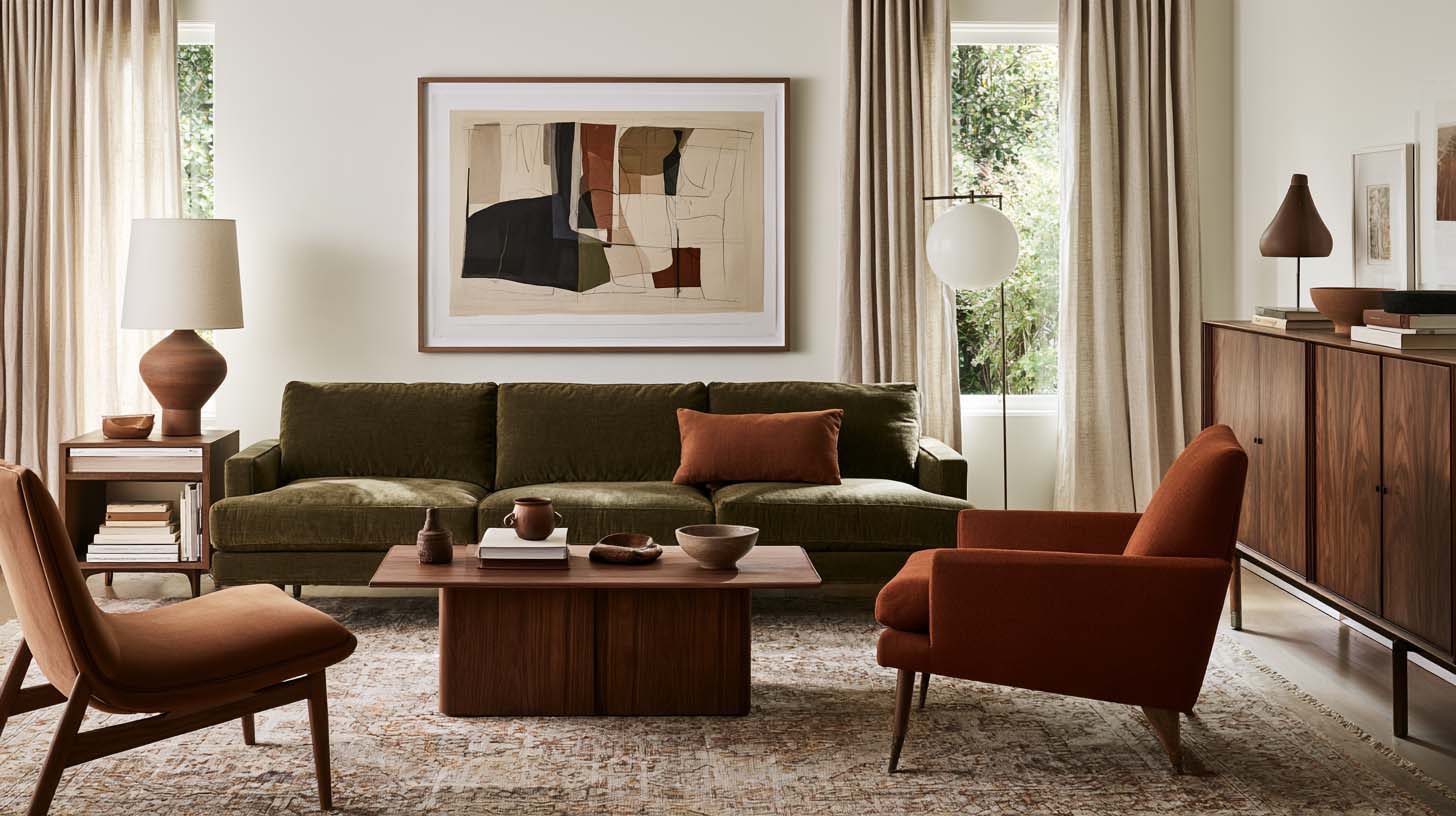
The living room essentials list is usually presented like a shopping list. A sofa, a coffee table, a rug, a lamp, a television, curtains, and pillows, and the room is supposedly done. But owning the correct categories of furniture does not guarantee a good living room. The better question is not what products every man should buy.
It is what functions every serious living room should support. Somewhere comfortable to sit. A surface within reach. A conversation area that feels grounded. Useful light after sunset. Something worth looking at besides a television. Something personal.
Enough storage that daily clutter does not dominate. Window treatment where the room needs it. Enough hospitality infrastructure to receive another person comfortably. Those are the real men's living room essentials.
The exact products can change completely. If you are not sure which of these functions your own living room is missing, TMH's Full-Service Interior Design can plan the room with you.
Essential #1: Proper Seating
Start here. A living room exists primarily because people sit in it. That usually means a sofa. But the question is not whether you technically own one. The question is whether it fits the room, your body, the way you live, the number of people you reasonably expect, and the architectural scale.
A giant sectional may be perfect. A 78-inch sofa may be better. Two sofas might work in a large conversation room. One sofa and two chairs may create the strongest arrangement in another. Do not buy by category. Plan the seating composition.
One Comfortable Chair Changes the Room
Even if you live alone, an additional chair matters. It creates another seating position, a place to read, a seat for a visitor, another material, and a chance to introduce color or pattern. The chair can often carry more personality than the sofa.
It might be a leather club chair, something in rust wool, olive velvet, or plaid, a mid-century wood frame, or a wingback. A room with one good sofa and one distinctive chair often looks more developed than a room filled with matching upholstery.
The Seating Should Allow Conversation
If every seat points in exactly the same direction toward the television, the room has one primary mode. Watching. That may be appropriate in a dedicated media room. In the living room, angle at least some seating so people can speak without turning their whole bodies.
Two chairs across from the sofa. One chair at 90 degrees. A pair angled slightly toward the center. The arrangement does not need perfect symmetry. It simply needs to acknowledge that human beings may look at one another occasionally.
Essential #2: A Surface Within Reach
Sit in every seat. Where does the drink go? This simple question reveals incomplete living rooms immediately. It could be a coffee table, a side table, a drink table, an ottoman with a tray, or a console behind the sofa. The exact object can vary. But a person should not need to lean four feet forward or set a glass on the floor. This is one of those invisible hospitality details that makes a room feel comfortable before anyone consciously notices why.
Coffee Tables Are Not Mandatory
The coffee table is so conventional that we rarely question it. Some rooms benefit from one. Others may work better with a large ottoman, two smaller tables, nesting tables, several side tables, or a round central table. If circulation is tight, the traditional rectangular coffee table may be the exact object making the room difficult to use. Function outranks convention.
Essential #3: A Rug Large Enough to Ground the Seating
A living room rug defines territory. This is especially valuable in open floor plans. The rug tells the eye: This furniture belongs together. A rug floating only beneath the coffee table does the opposite. It creates a tiny island surrounded by disconnected seating.
Use enough rug to establish a meaningful relationship with the sofa and chairs. The specific arrangement depends on room size, but the principle is consistent. The textile should visually support the furniture.
The Rug Should Add Something the Furniture Does Not
If the room contains brown leather, walnut, and black metal, do you need a brown or gray rug? Perhaps. But the room might benefit more from faded red, muted blue, cream, olive, a traditional pattern, or textural wool. The rug occupies enormous visual area. Use that opportunity.
Essential #4: More Than One Type of Light
A room can contain expensive furniture and still look unfinished at night because the lighting was treated as electrical infrastructure rather than interior design. Every useful living room needs ambient light. But it also benefits from task and accent sources.
The U.S. Department of Energy distinguishes these same three broad residential lighting functions: ambient lighting for general illumination, task lighting for activities, and accent lighting for visual emphasis. (EERE Energy)
In practice, that means a ceiling fixture or architectural lighting, a table lamp beside the sofa, a reading lamp near a chair, a picture light over artwork, and perhaps sconces or shelf lighting. Different sources allow different activities.
Your Ceiling Light Is Not the Entire Lighting Plan
One fixture in the center of the room creates illumination. It rarely creates atmosphere. Lamps place light closer to people and materials. They reveal wood grain, leather, wool, artwork, stone, and books. They also create pools of brightness rather than illuminating every square foot equally. That hierarchy makes rooms feel more comfortable.
A Reading Chair Needs Reading Light
If you cannot comfortably read in the chair after sunset, you do not have a reading chair. You have a chair placed near books. Give the activity enough light. This sounds overly practical. That is precisely why it improves the design. A functional arrangement always looks more convincing because each object has a reason to be where it is.
Essential #5: Something Worth Looking at Besides a Screen
Televisions are useful. They are also enormous black rectangles. If they are the only strong vertical object in the living room, the room inevitably becomes about the screen. Give the eye another destination: artwork, bookshelves, a fireplace, a large plant, a window view, an architectural detail, or a collection. A living room should still have a visual identity when the television is off.
Art Should Have Enough Scale
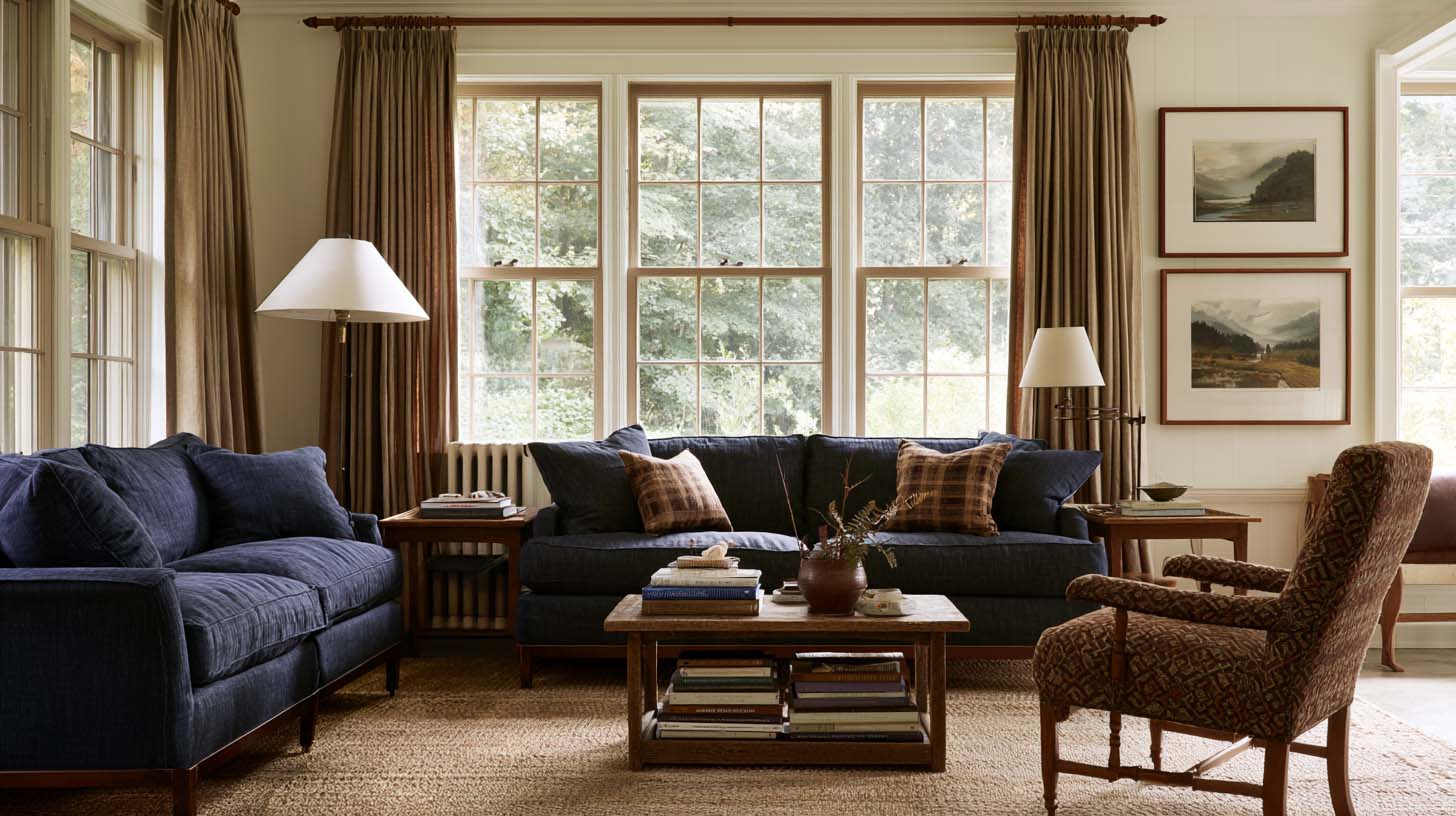
A 90-inch sofa with one 14-inch print above it looks unresolved. The artwork needs enough visual territory to communicate with the furniture below. That might mean one large painting, a pair, a triptych, a gallery wall, a large photograph, or a textile.
The exact solution depends on the art you own. Do not solve the scale problem by filling the wall with generic decoration.
Essential #6: Something Personal
Without personal material, even a beautifully designed room can feel transferable. It could belong to anyone. Add something that complicates that: books, an object from your travels, a framed photograph, an inherited piece, art you chose yourself, records, a collection, a historical object, or a piece related to your work. This is where the living room begins changing from a designed room into your room.
Personal Does Not Mean Cluttered
One object with a real story may carry more weight than ten generic accessories. A ceramic acquired while traveling. Old photograph. Antique box from family. Several books you genuinely use. These are enough to give a surface identity. You do not need to turn the living room into an autobiography written across every shelf.
Essential #7: Window Treatment Where the Room Needs It
Some architecture looks excellent with bare windows. Many residential rooms do not. Curtains provide privacy, light control, softness, verticality, color, pattern, and acoustic absorption. They also make windows look finished. If you currently have builder blinds and feel that something remains incomplete despite good furniture, the windows may be the missing piece.
Curtains Can Be Quiet
It might be warm ivory linen, taupe wool, a muted stripe, deep blue, or olive. You do not need elaborate drapery. The purpose may simply be giving the room a softer edge around the architecture.
Essential #8: Closed Storage
Living rooms accumulate ugly necessities: remote controls, controllers, cables, blankets, children's items, games, paperwork, chargers, extra candles, and electronics. If all storage is open, those things eventually become the decor. A cabinet, a media console, a drawer table, built-in lower cabinetry, or a storage ottoman gives them somewhere to go.
Give the room somewhere to put ordinary life. Then the things you actually want visible become easier to see.
Essential #9: A Useful Table or Console Beyond the Coffee Table
Most living rooms benefit from one secondary horizontal surface, such as a console behind the sofa, a cabinet against the wall, sideboard-style storage, or a library table. This gives you somewhere for a lamp, art, books, a ceramic, and storage. It also helps develop a wall that would otherwise remain empty.
Do not add one simply to fill the room. But if the architecture contains a long unused wall, a substantial console often contributes more than several pieces of wall decor alone.
Essential #10: Enough Hospitality Infrastructure for Another Person
This is perhaps the least discussed living-room essential. Can someone come over without your home entering emergency mode? There should be a seat, a surface, reasonable light, a clean bathroom nearby, somewhere to set a coat if needed, a glass, and a little room to move.
The living room historically has been one of the home's primary social spaces. The Smithsonian American Art Museum describes the nineteenth-century parlor as a center of domestic life in which household pictures and furnishings communicated family aesthetics, values, and history. (Smithsonian American Art Museum)
The modern living room has changed enormously. Its hospitality function has not disappeared.
Essential #11: Enough Empty Space to Move
Furniture is not improved by quantity. A good living room contains circulation: paths between seats, enough distance around tables, a clear entry, and some visual rest. You should not need to turn sideways every time you walk through the room.
This is why "what every living room needs" cannot become a literal product checklist. Your room may not have physical space for every conventional furniture category. The empty space may be more useful.
Essential #12: A Material That Ages or Has Texture
Perfectly new, perfectly smooth rooms can feel visually thin. Introduce something with surface, such as wood grain, wool, leather, stone, linen, ceramic, an old rug, or bronze, and perhaps one object with visible age. This gives the room material depth without requiring more decoration.
Essential #13: One Element With Color
A living room can be neutral. It should not accidentally become colorless because every purchase felt safer in gray. Color might enter through an olive chair, a rust rug, a deep-blue sofa, a forest-green wall, oxblood artwork, a clay curtain, or a traditional rug carrying several muted colors.
You do not need a "pop of color." You need enough chromatic variety for the materials to remain distinct.
Essential #14: A Place for the Things You Actually Do
Do you read? Create a reading zone. Listen to records? Give them real storage. Play chess? Leave room for a table if the activity is genuine. Collect books? Use shelves. Entertain? Prioritize conversation seating. Watch films? Integrate the television properly. The room should reflect activities. This is how it acquires character without decoration for decoration's sake.
The Living Room Does Not Need Everything
It may not need a coffee table, sectional, floor lamp, plant, bookshelf, fireplace, bar cart, ottoman, bench, console, or two side tables. Trying to include every category can create a crowded room. The essentials are functions. How you satisfy them depends on the room.
A Small Living Room Has the Same Requirements With Fewer Objects
A small living room still needs comfortable seating, a surface, light, storage, and personality. But several functions may need to share one object. Storage ottoman. Side table with drawer. Wall sconce instead of floor lamp. Media cabinet that also stores household items.
One strong chair rather than two. The room does not become less complete because it owns less furniture.
A Large Living Room Needs More Than Larger Furniture
Large rooms create another challenge. Furniture can begin floating without relationships. Instead of simply buying a bigger sofa, create zones: a primary conversation group, a reading area, a game table, secondary chairs near the fireplace, and perhaps a small writing surface. A large room becomes convincing when the scale allows several legitimate activities rather than one enormous seating arrangement marooned in the center.
Designer Eyes: Test the Room at 9 p.m.
Many living rooms are judged during the day. Try another test. At night: Turn off the television. Set the lighting where you naturally want it. Sit in every seat. Can you see artwork? Does the wood still look good? Can you read? Does the room feel comfortable without the screen providing light and activity? If the room becomes lifeless once the television is off, the design may still be underdeveloped.
Do Not Solve Every Empty Surface With Decor
A room can contain all the living room essentials and still have an empty section of console. That is fine. One chair can have no pillow. One shelf can have open space. The coffee table can hold one book rather than a complete arrangement.
The point of the essentials is creating a room that works. Not filling every remaining inch once it does.
The TMH Perspective
What every living room needs is surprisingly simple. Somewhere proper to sit. Somewhere to set something down. A rug that establishes the room. Light where people actually are. Something worth looking at. Something personal. Storage for the things that are not worth looking at.
Enough hospitality to receive someone. Enough empty space to move. That is the foundation. Everything else is interpretation. A good living room is not complete because it contains all the correct objects. It is complete because nothing important is missing.
The U.S. Department of Energy's residential lighting guidance provides a useful technical foundation for distinguishing ambient, task, and accent lighting rather than expecting one overhead fixture to perform every function. (EERE Energy) The Smithsonian American Art Museum's documentation of the historic parlor offers useful cultural context for the living room's enduring role as a social space where furnishings and objects communicate the identity and values of the household. (Smithsonian American Art Museum)
If your living room contains the obvious furniture but still feels incomplete, TMH's Full-Service Interior Design can resolve what is actually missing, whether that is layout, rug scale, lighting, art, seating, storage, or simply a stronger relationship among what you already own.
Frequently Asked Questions
What are the most important men's living room essentials?
Comfortable seating, reachable surfaces, a properly scaled rug, layered lighting, art or another focal point, personal objects, useful storage, window treatments where needed, and enough space to receive another person comfortably.
Does every living room need a coffee table?
No. Side tables, ottomans, nesting tables, or smaller central tables may work better depending on the furniture arrangement and circulation.
How many lamps should a living room have?
There is no universal number. The room should have enough lighting layers to provide general visibility, task light where activities occur, and some lower-level atmosphere after sunset.
Does every man's living room need a TV?
No. If you use one, integrate it deliberately. The room should still have a visual and social identity when the screen is off.
What makes a living room feel complete?
A complete living room supports sitting, conversation, basic hospitality, useful lighting, storage, and personal identity without relying on decorative clutter.


Facebook
Instagram
Youtube