How to Choose a Masculine Office Desk
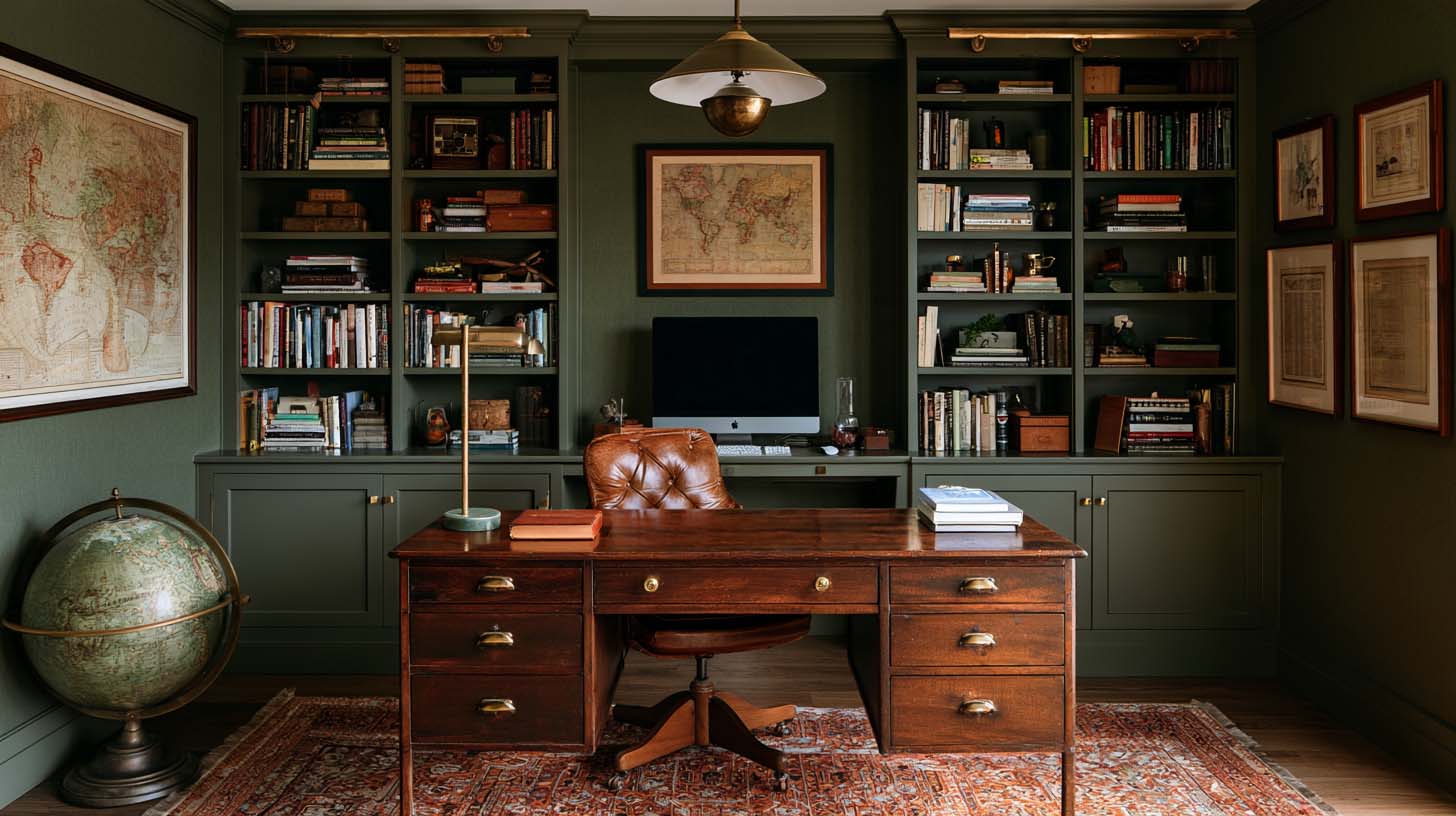
A home office often gets designed backward.
First comes the room. Then paint. Bookshelves. A leather chair. Artwork. Lighting.
Finally, a desk is dropped into whatever space remains.
It should usually happen the other way around.
The masculine office desk is both the room's primary tool and, in many offices, its largest freestanding piece of furniture.
Its depth determines monitor placement. Its width affects storage. Its back may be visible from the doorway. Its position determines your camera background. Its material influences whether the office feels corporate, traditional, modern, or collected.
Choosing the right desk therefore has much less to do with finding something that looks masculine and much more to do with deciding what kind of work the desk actually has to support. If you are not sure whether your current desk is the right fit for your office, a Room Audit is a fast way to get an outside opinion.
Start With the Work
Before style, ask what happens on the desk.
One laptop? Large monitor? Ultrawide display? Two or three monitors? Keyboard and mouse? Documents? Drawing? Writing by hand? Calls? Printer? Speakers? Audio equipment? Samples?
The desk needs enough width and depth for these tasks without becoming storage for unrelated objects.
Ergonomic workstation guidance generally recommends enough desk depth to position a monitor at least about 20 inches from the eyes, enough surface area for the keyboard, mouse, monitor, and other frequently used items, and sufficient clear space beneath for the legs.
That practical requirement should be resolved before worrying about whether the desk is walnut or oak.
Desk Depth Matters More Than Most People Realize
A shallow desk can look elegant.
Then the monitor arrives. Keyboard. Laptop dock. Speakers. Notebook.
Suddenly there is nowhere to work.
For a computer-heavy office, depth is especially important.
Monitor viewing distances are generally recommended around 20 to 40 inches depending on screen size and individual comfort. The monitor should usually sit directly in front of the user, with the top of the screen around or slightly below eye level.
If your desk cannot physically support the setup, styling will not fix it.
This is also why some beautiful antique writing desks make poor full-time computer workstations. They were designed for writing. Not two 32-inch displays.
The Executive Desk
The executive desk is designed to carry visual authority.
Broad top. Significant depth. Drawers or pedestals. Substantial front. Often finished on all sides so it can float in the room.
Walnut and mahogany versions can be particularly strong in traditional offices.
This format works when you need meaningful storage, the room is large enough, the desk is intended to become the central furniture piece, a large monitor or multiple monitors need room, or the desk may be seen by visitors.
The danger is scale. A huge executive desk in a small bedroom-office can make the room look like a regional bank branch.
Use one because you need its function and presence. Not because "executive" sounds masculine.
The Writing Desk
Writing desks are usually lighter. Simple top. Four legs. Minimal drawers. Less visual mass.
They work beautifully in studies, libraries, guest-room offices, lighter traditional interiors, minimal workspaces, and rooms where the desk should not dominate.
A writing desk is excellent for laptop work, correspondence, reading, and lighter tasks. It becomes less useful when substantial equipment and storage are required.
Its greatest aesthetic advantage is that it looks like furniture rather than office equipment.
The Partner's Desk
Partner's desks were historically designed for use from both sides. They tend to be substantial and fully finished.
In a home office, that can make them excellent freestanding objects even when only one person uses the desk.
The format works especially well in large traditional studies where the desk sits in the middle of the room rather than against a wall.
But again, function matters. Traditional examples may not contain modern cable management, monitor depth, keyboard ergonomics, or useful drawer configurations.
A reproduction or custom desk can preserve the visual language while accommodating current work.
The Campaign Desk
Campaign furniture developed around portability, often using compact forms, straight silhouettes, and distinctive brass hardware.
In interiors, campaign desks are useful because they bridge traditional and modern styles unusually well.
A walnut or dark wood campaign desk can sit in Traditional English, Modern Heritage, Collected Eclectic, Mid-Century-adjacent rooms, or contemporary spaces needing one historical note.
The brass corners and hardware provide enough character that the desk itself does not need heavy ornament.
This is one of the most useful desk forms when you want a masculine office to feel refined without becoming corporate.
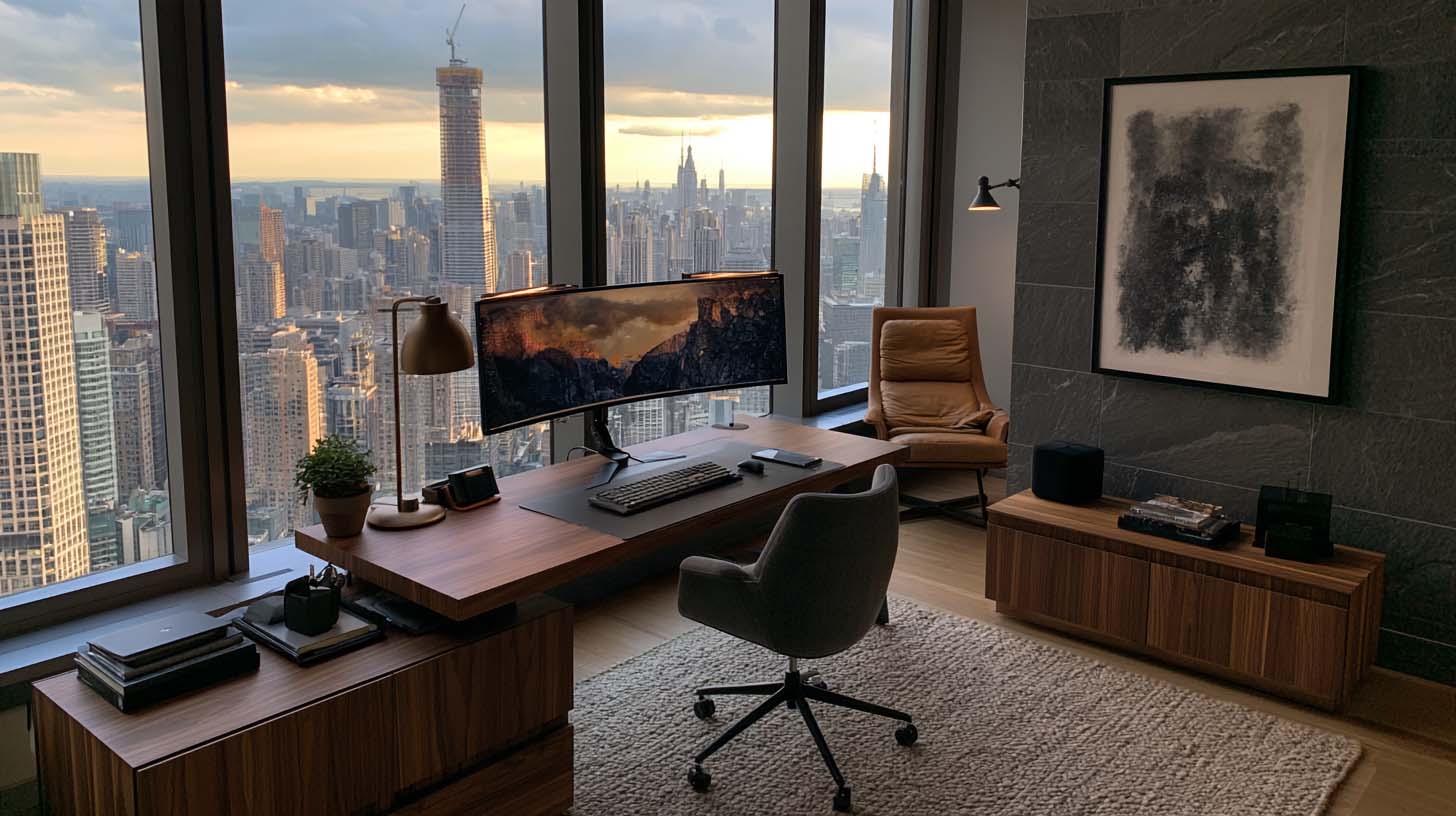
The Modern Desk
Modern desks reduce visual information. Slab top. Minimal drawers. Clean legs. Integrated cable access. Adjustable height in some versions.
These are often better suited to technology-heavy work because they can be designed around monitors, charging, cable management, and accessories.
The challenge is preventing them from looking like generic workplace furniture.
Material helps. Walnut. White oak. Stone detail. Blackened metal. Bronze. Leather writing surface.
A modern desk can remain highly functional while still belonging to a residential room.
Standing Desks Need to Look Like Furniture Too
Height-adjustable desks are useful for people who want to alternate positions.
But many residential versions look unmistakably utilitarian. Black mechanical legs. Thin top. Visible controls. Cable bundles.
If the desk is central to a refined office, consider a better wood top, concealed cable trays, thoughtful control placement, architectural side panels where feasible, and cabinetry designed around the standing range.
The mechanics do not need to become the visual identity of the room. Function should be integrated.
Desk Height Is an Ergonomic Question Before an Aesthetic One
Standard fixed desks are often around 29 to 30 inches high.
That does not mean this height works comfortably for everyone.
Workstation fit depends on the user, and it generally helps to keep keyboard and input devices around elbow height, with enough adjustability in chair, work surface, or keyboard support to maintain neutral posture.
This matters particularly for taller or shorter users.
A beautiful desk that forces raised shoulders or bent wrists during eight hours of work is not a successful desk.
Adjustability can be more valuable than stylistic purity.
Monitor Requirements Should Influence the Desk From Day One
Do not design the room as though the monitor will somehow disappear. It will be there.
If you use one ultrawide display, account for its width. If you use dual monitors, determine total span. If the monitor arm clamps to the desk, check the edge profile and rear clearance. If speakers sit beside the display, include them. If a camera sits above it, consider the background.
The primary monitor should generally sit directly in front of the user, with frequently used components kept within easy reach.
A strong office acknowledges technology rather than pretending the desk will remain an empty wood surface.
Cable Management Is Part of Good Furniture Planning
The back of the desk matters.
Power. Monitor cables. Charging. Audio. Ethernet. Lighting. Docking station.
A desk placed against the wall can conceal more easily. A floating desk exposes everything.
Plan accordingly. Grommets. Under-desk trays. Channels. Floor outlets where architecture permits. Cable sleeves. Integrated power.
One of the fastest ways to make an expensive office feel unfinished is to place a beautiful walnut desk in the center of the room and allow six black cables to drop behind it.
A Masculine Office Desk Should Have Enough Visual Weight
A lightweight desk can work well.
But if the room contains floor-to-ceiling bookcases, substantial chairs, a large rug, and strong architecture, a very thin desk may look timid.
Visual weight can come from top thickness, pedestals, drawer blocks, substantial legs, dark material, large dimensions, a leather inset, or brass detail.
You do not need all of these. One or two may be enough.
Designer Eyes: Look From the Doorway, Not the Chair
You spend most of your time sitting behind the desk. Everyone else sees it from another angle. Stand at the office entrance. Does the desk present a finished front? Are wires visible? Does the chair overwhelm it? Does the desk feel centered in the room? Is the monitor the first thing you see? The doorway view often reveals whether the office was designed as a room or merely as a workstation.
Floating the Desk Can Transform the Office
Placing the desk against a wall is practical. Sometimes it is correct.
But floating the desk can make the room feel much more substantial.
It creates a stronger center, better views, a proper relationship to bookshelves, and a more intentional visitor-facing arrangement.
But it requires space. You need circulation behind the chair, cable planning, a finished back on the desk, and enough room to avoid making the layout feel congested.
If those conditions exist, floating the desk can change the office from "work setup" to "room."
Facing the Window Is Not Always Ideal
A beautiful view is tempting. But monitor glare matters. So does the camera background. So does turning your back to the door.
Ergonomic guidance generally recommends placing monitors to minimize glare, often positioning the display perpendicular to windows rather than directly facing strong light.
In residential design, the right answer may involve balancing all of these factors.
Perhaps the desk turns 90 degrees to the window. You still receive daylight. The monitor becomes easier to see. The doorway relationship improves. The background becomes more intentional.
Storage Should Match the Work
If you do not use paper, you may not need a desk with six file drawers. If you handle contracts, drawings, or samples, you may.
Desk storage should correspond to actual work.
Shallow drawers for pens, notebook, charging, glasses, and small tools.
Deep drawers for files, equipment, and larger supplies.
In many modern offices, the desk itself can remain relatively clean while storage moves to adjacent cabinetry.
That often creates a stronger room because the desk becomes visually lighter without sacrificing organization.
Do Not Buy a Desk Set
Desk plus matching credenza plus matching bookcases plus matching file cabinet.
Everything coordinates. Nothing surprises.
This is the office equivalent of the matching living-room suite.
A better approach might be a walnut campaign desk, painted bookcases, an antique leather chair, bronze lamps, and an oak credenza.
The room begins to feel collected.
Consistency can come from tone, material, and proportion without every piece sharing a product line.
The Desk Chair Should Not Be Chosen Separately
Chair height. Arm clearance. Seat depth. Desk apron. Keyboard position. All interact.
A substantial leather desk chair may look excellent but fail to slide beneath a traditional desk because the arms are too high.
A modern ergonomic chair may function brilliantly but visually overwhelm a delicate writing desk.
The chair and desk need to be tested as a pair. Function first. Then visual relationship.
Wood Species Changes the Personality
Walnut feels warm and refined. White oak can feel architectural and contemporary. Mahogany carries more traditional formality. Dark-stained oak can feel heavier. Painted wood can make a desk less dominant.
There is no universally masculine wood. What matters is the character it introduces relative to the rest of the office.
A Desk Can Be the One Old Piece in a Modern Office
A vintage campaign desk. Old partner's desk. Simple antique writing table.
These can introduce chronology into a modern room.
The contrast works particularly well when surrounding cabinetry and technology are contemporary. The old desk becomes more visible because nothing else is imitating it.
This is often better than designing the entire office around period furniture.
The TMH Perspective
The right office desk does not begin with a style. It begins with the work.
How many hours are spent there? What equipment has to fit? Does the desk float? Is the back visible? Do you write by hand? Do you need files? What should someone see behind you on a call?
Once those questions are answered, the aesthetic decision becomes much easier.
In our design work, distinguished offices often emerge from treating the desk as both a tool and a major piece of furniture. Ignore either side of that equation and the room suffers.
If your office needs to support serious daily work but you do not want it to look like a corporate workstation, TMH Full-Service Interior Design can develop the desk, storage, monitor setup, seating, lighting, camera background, and architecture as one complete room.
Frequently Asked Questions
What makes a desk look masculine?
Scale, material, visual weight, hardware, silhouette, and placement all contribute. Walnut, oak, leather, bronze, and blackened metal can help, but the overall composition matters more.
How deep should a desk be for a home office?
It depends on equipment, but the desk should provide enough depth to place the monitor at a comfortable distance. General guidance recommends at least about 20 inches from the eyes to the screen.
Is an executive desk better than a writing desk?
Only if the work and room justify it. Executive desks provide more storage and visual mass, while writing desks are lighter and often better for laptop work or smaller rooms.
Should a home office desk face the wall or the room?
Either can work. Floating a desk can create a more distinguished room, while wall placement may simplify wiring and save space. Consider circulation, glare, camera background, and the view from the doorway.
Is a standing desk appropriate in a masculine home office?
Yes. The challenge is integrating the mechanics so the desk still feels residential. Better materials, cable management, and thoughtful cabinetry can help.

Facebook
Instagram
Youtube