How to Design a Distinguished Masculine Home Office
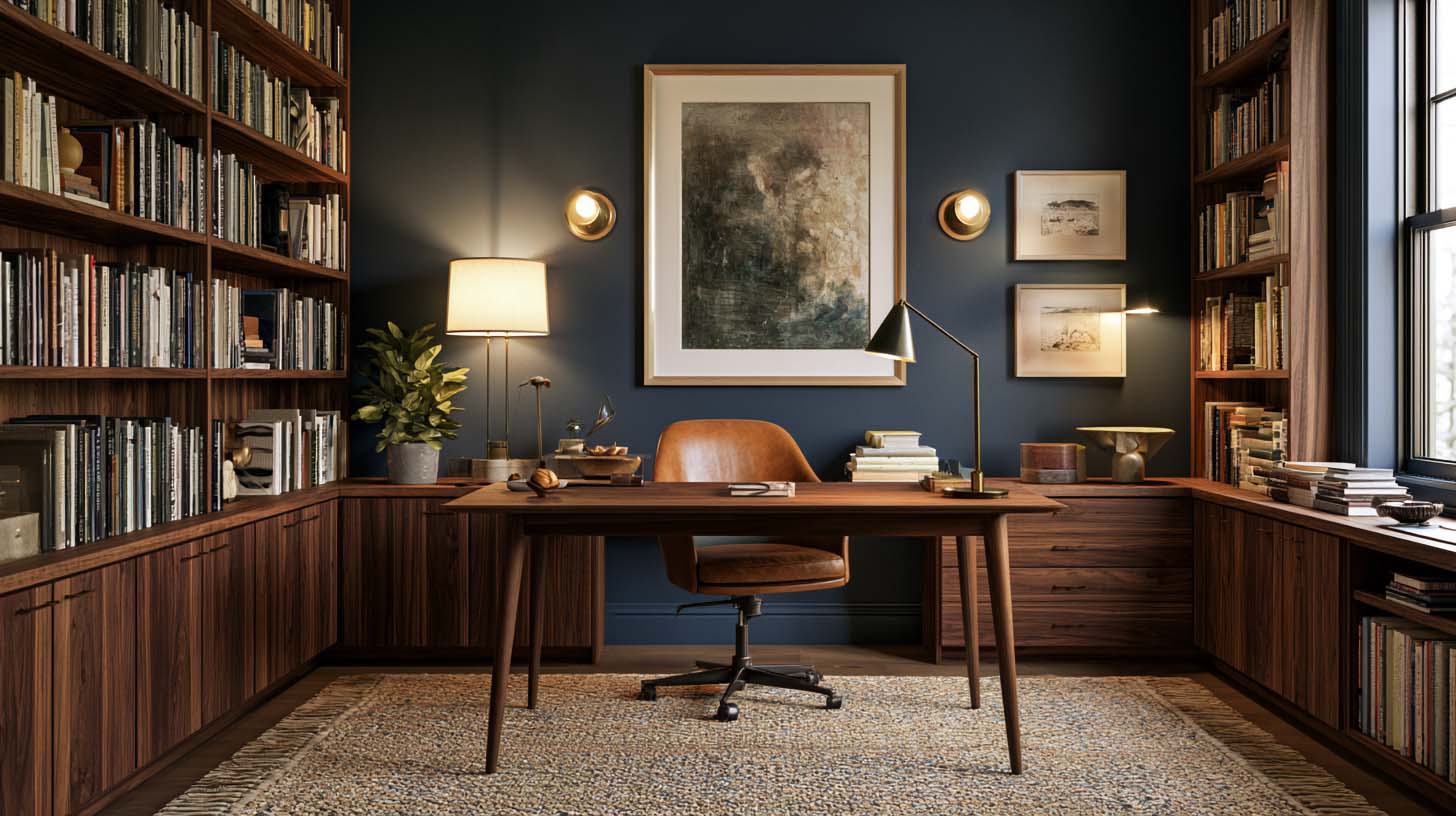
A masculine home office should feel like a room in which serious work happens. That does not mean enormous executive furniture, walls painted nearly black, and enough tufted leather to suggest a private club. Nor does it mean accepting the opposite extreme: a monitor, ergonomic chair, and desk pushed against whatever wall happened to have an outlet.
A distinguished masculine home office occupies the territory between those two clichés. It works. It also has presence. If you are not sure where your own office currently falls short, TMH's Full-Service Interior Design can plan the room before you change anything.
The desk sits where it belongs. Lighting supports both screens and paper. Books and equipment have proper storage. Technology is integrated rather than worshipped. Artwork and personal objects reveal something about the man using the room. The difference between a workstation and a study is not decoration. It is that the entire room has been designed around work.
Start With the Work, Not the Desk
Before deciding what a masculine office design should look like, define what actually happens there. Someone who spends eight hours on video calls needs a different room from someone who primarily writes. An attorney with paper files has different storage requirements from an entrepreneur working almost entirely digitally. Someone who reads extensively may need a genuine reading chair and strong task light. Someone working with multiple monitors needs enough desk depth to keep the screens from dominating his field of vision.
The office should emerge from these patterns. This sounds obvious, yet home offices are often designed in reverse. A handsome desk is purchased first, placed wherever it fits, and every work requirement is forced to adapt around it. Instead, begin with function. Then make function beautiful.
Give the Desk a Deliberate Position
Desk placement determines more of the room than desk style. A desk pressed flat against a wall can be perfectly sensible in a compact office. It conserves space and simplifies cable management. But where the room allows it, a freestanding desk can create considerably more authority.
Positioning the desk into the room establishes it as furniture rather than equipment. The chair has breathing room. The view becomes deliberate. The background behind you can be composed separately. Natural light also deserves consideration. Current GSA workplace guidance recommends maximizing useful daylight and views while controlling glare and positioning workstations so users can alter their orientation relative to windows when necessary. (U.S. General Services Administration)
Practically, that usually means avoiding direct, uncontrolled sunlight hitting your screen or your eyes. The romantic image of a desk directly facing a bright window can become extremely irritating by midmorning.
Designer Eyes: Look From the Door Before You Sit Down
When evaluating desk placement, stand in the doorway. Does the desk look intentional? Or are you seeing the back of a monitor, tangled wires, and the least attractive side of the furniture? A home office is still a room when nobody is working. The composition should make sense from its entrance.
Choose the Right Type of Desk
A masculine office desk does not need to be enormous. It needs to support the work and possess enough presence for the room. A writing desk works beautifully when equipment requirements are modest. An executive or pedestal desk provides additional storage and visual weight. A partner's desk can become highly architectural in a large study. Campaign-style desks offer a restrained historical character. A clean contemporary desk may be exactly right for a modern apartment.
Depth is frequently underestimated. A shallow desk may look elegant until a monitor, keyboard, notebook, phone, lamp, and coffee cup occupy it. Think about the working surface before falling in love with the silhouette.
Do Not Sacrifice Ergonomics for Character
There is no prize for enduring an uncomfortable office chair because leather looked better in the photograph. If you work in the room every day, your body is part of the design brief. NIOSH's current office-safety guidance emphasizes avoiding prolonged awkward postures, overreaching, and long periods of unbroken sitting or standing; in some cases, furniture or equipment should be changed to fit the worker rather than forcing the worker to fit the setup. (CDC)
This means the right chair may be a modern ergonomic task chair. That is fine. A distinguished office is not made less sophisticated because one object is clearly designed for human anatomy. If the aesthetics of a conventional ergonomic chair bother you, there are alternatives, upholstered swivel chairs, leather task chairs, and more architectural office seating, but comfort, adjustability, and posture still deserve priority. The chair you occupy for six hours should not be selected by the same criteria as a decorative chair used twice a month.
Build the Lighting Around Several Jobs
The home office asks more from lighting than almost any other room. You may need comfortable ambient light, light for reading, light for writing, light around a computer screen, light that looks flattering on camera, and light for artwork and shelves. Trying to accomplish all of this with recessed lights usually produces an unpleasant room.
GSA's lighting guidance distinguishes general, task, accent, and daylight sources and notes that adjustable task lighting can improve occupant control while lower general illumination can reduce excessive brightness around screens. (U.S. General Services Administration) At home, translate that into layers. Use daylight when it helps. Control glare with curtains or shades. Add a real desk lamp. Use ambient lamps to prevent the monitor from becoming the brightest object in the room. Illuminate artwork or shelving selectively. The goal is a room that works at 10:00 a.m. and still feels comfortable at 9:00 p.m.
Bookshelves Give the Room Purpose
Few elements transform an office into a study as effectively as bookshelves. Not because books automatically make someone look intellectual. Because bookshelves provide architecture, storage, verticality, and an obvious place for accumulated knowledge. They can contain actual working materials: reference books, professional texts, history, biographies, literature, and objects associated with your work or interests.
A home office begins to look contrived when shelves contain mostly decorative accessories selected to create the idea of intelligence. Let books dominate. Allow some open space. Use objects sparingly. If you have more books than decorative objects, you are already ahead.
Case Furniture Matters
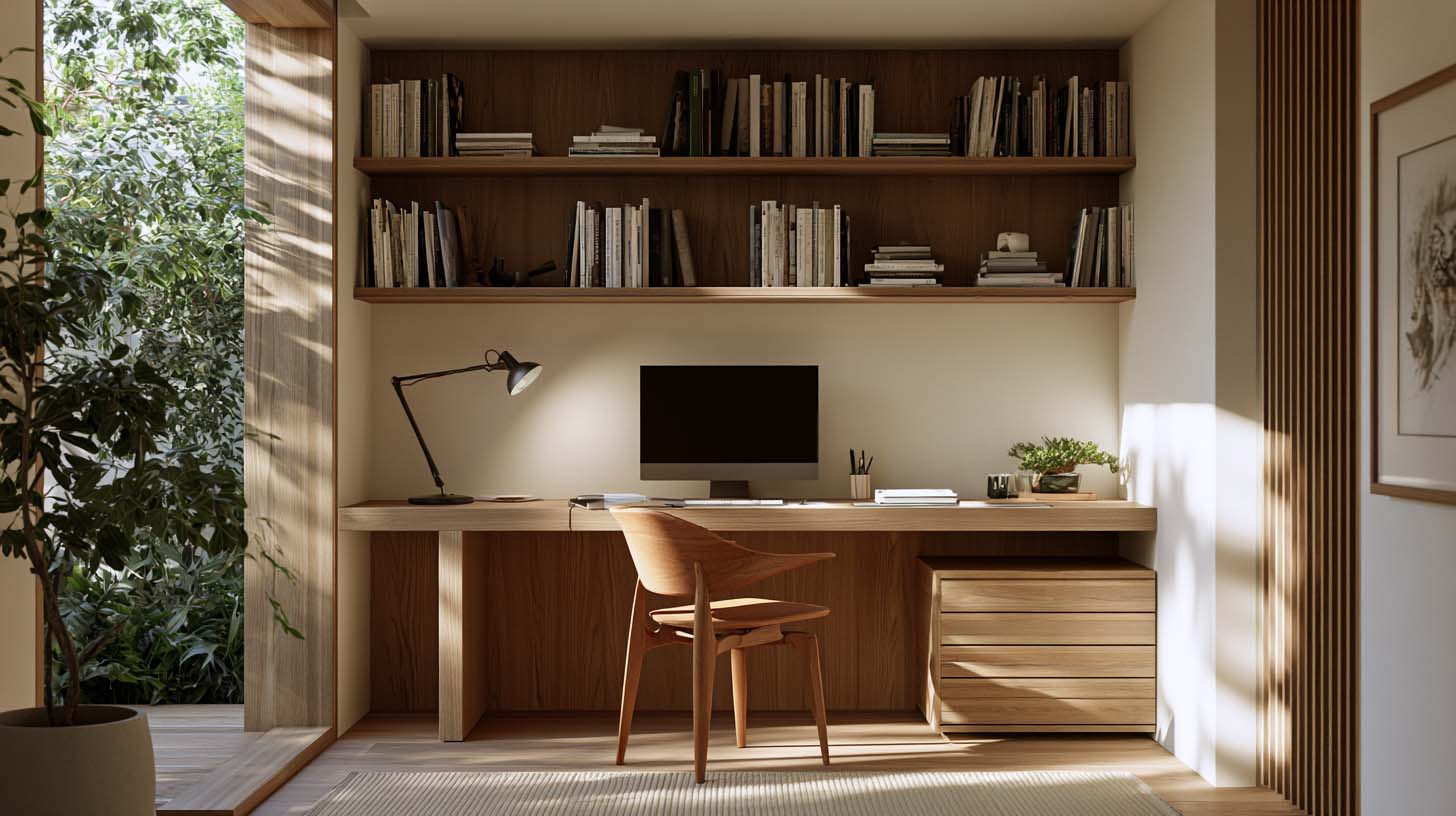
A desk and chair alone leave many offices visually underdeveloped. Case furniture gives the room a second layer of usefulness. A credenza can store files, printers, supplies, or electronics. A cabinet can conceal equipment. A bookcase can occupy an unresolved wall. A chest can hold miscellaneous tools and documents while bringing age or material richness into the room. This is especially important in larger offices where an isolated desk can look stranded. The room needs enough furniture to feel architecturally occupied, but not so much that circulation disappears.
Hide the Machinery Without Pretending It Does Not Exist
Computers are not ruining interior design. Poor integration is. Cables matter. Printer placement matters. Chargers, routers, external drives, microphones, and cameras all matter. The goal is not hiding every piece of technology behind antique cabinetry. It is creating hierarchy.
The monitor should not necessarily be the first thing visible through the doorway. Cables should not hang freely if they can be managed. A printer need not occupy the most beautiful surface in the room. Storage should anticipate equipment. Good masculine office design acknowledges that work requires machinery while refusing to let machinery become the entire aesthetic.
Compose the Background for Video Calls
For many men, colleagues and clients now see one wall of the home office more frequently than any guest physically entering it. Treat that view intentionally. A background can include bookshelves, artwork, cabinetry, a restrained collection, architectural detail, or simply a strong painted wall with one excellent piece of art.
Avoid designing a Zoom background so aggressively that the room begins to look like a set. The best background is simply an attractive part of the office that happens to sit behind you. It should reveal some character without turning into a résumé. Diplomas, awards, books, photographs, and objects can appear naturally. They do not all need to face the camera.
Use Artwork That Supports Thought Rather Than Fills Space
The office is an ideal room for art with intellectual or personal relevance: maps, architectural drawings, landscape painting, photography, historical prints, portraiture, technical drawings, or contemporary work. Art connected to a profession or serious interest can be particularly effective because the office naturally carries that part of your identity.
The danger is obvious symbolism. A finance professional does not require a bronze bull. An attorney does not require scales of justice. An entrepreneur does not need a framed quotation about hustle. Your profession is already visible in what you do. The room can afford more nuance.
Materials Determine Whether the Office Feels Corporate or Residential
Corporate offices often rely heavily on synthetic surfaces, acoustic systems, modular furniture, commercial carpet, glass, and highly uniform lighting. A home office can feel richer by introducing materials associated with the rest of the home: walnut, oak, wool, leather, linen, stone, brass, bronze, ceramic, and plaster.
A wool rug beneath a modern ergonomic chair immediately softens the technical nature of the workstation. A ceramic lamp beside a monitor introduces another material language. A walnut credenza can make filing and electronics feel part of the room rather than office equipment temporarily stored at home.
A Rug Can Change the Entire Character of the Office
Many home offices consist of a desk, chair, hard floor, and white walls. The result is often acoustically and visually harsh. A rug helps in several ways at once, introducing pattern, softness, color, and a defined zone around the desk.
A faded traditional rug can give an otherwise contemporary office instant depth. A wool solid can keep things quieter visually. A geometric rug may suit a more modern room. Make it large enough to relate to the desk and chair rather than placing a tiny rectangle beneath only the chair wheels.
Add a Second Place to Sit
If the office has sufficient space, one of the best additions may have nothing to do with the desk: a reading chair, two conversation chairs, a small sofa, or a bench. This gives you somewhere to take a phone call, read away from the monitor, think, or speak with another person.
It also changes the room psychologically. The office stops being a cockpit and becomes an environment. For someone who spends significant time working from home, that distinction can matter enormously.
Let Personal History Enter the Room
A masculine home office is a natural place for objects connected to accomplishment, travel, collecting, education, and interests. But there is a fine line between identity and self-advertisement. A framed diploma can be appropriate. So can an award, a model, a photograph, an old tool from your profession, a family object, or a book connected to an important period of your life.
The strongest rooms distribute these things naturally rather than organizing them into an exhibit titled About Me. Your office should reveal character slowly.
Keep the Room Suitable for Concentration
A distinguished office does not need endless visual stimulation. The working area should have some calm. If every shelf is full, every wall contains art, every surface holds objects, and five competing materials surround the desk, concentration suffers visually even if you cannot articulate why.
Allow negative space. Keep the primary work surface relatively controlled. Put collections on the walls behind or beside you rather than directly in your immediate field of view if they become distracting. Sophistication often requires knowing where not to place something.
The Difference Between an Office and a Study
A workstation exists to facilitate tasks. A study supports a broader intellectual life. That is the direction worth pursuing, even if your job requires three monitors and spreadsheets rather than fountain pens and leather-bound books.
The room can accommodate serious technology and still offer books, art, comfortable light, a reading chair, natural materials, and objects with history. That combination is what makes a masculine home office distinguished. Not nostalgia. Not darkness. Not executive furniture. A room designed with enough care that work itself feels properly housed.
The TMH Perspective
One of the most common home-office mistakes is designing the camera view first and the actual working experience second. A shelf looks excellent behind the desk. The desk itself, meanwhile, receives glare all afternoon. The chair has nowhere to move. The lamp is decorative rather than useful. The printer cable crosses the floor. The office photographs well and works badly.
We reverse the order. First determine how someone sits, moves, sees, stores, reads, calls, and works. Then make those answers handsome. If your office works technically but still feels like a workstation dropped into a spare room, TMH's Full-Service Interior Design can develop the desk, storage, lighting, furniture, artwork, materials, and background as one cohesive environment built around the way you actually work.
Prefer to design it yourself? Homefeld, our guided room design tool, lets you upload photos of your room, explore a new look, and get a practical plan to put it together.
Frequently Asked Questions
How much natural light does a home office really need?
Enough to reduce reliance on overhead lighting during the day, but positioned so it does not create glare on a screen. A desk facing directly into a bright window usually causes more problems than it solves.
Is an ergonomic chair incompatible with a masculine, distinguished look?
No. A well-made ergonomic chair can sit comfortably in a distinguished office, especially when paired with substantial materials elsewhere in the room, like a walnut desk or a wool rug. Comfort should never be sacrificed for a specific silhouette.
How many books should a home office bookshelf actually contain?
Enough that books dominate the shelf rather than decorative objects. A shelf with mostly ornaments and only a few books tends to look staged rather than lived in.
What is the easiest way to make a video call background look intentional?
Position one strong visual element, a piece of art, a bookcase, or an architectural detail, directly behind where you sit, rather than relying on whatever happens to already be on that wall.


Facebook
Instagram
Youtube