Masculine Fabrics: How to Choose the Right Textiles
A room can have beautiful furniture and still feel slightly wrong because the fabrics were treated as an afterthought.
The sofa is the right shape. The chairs have good proportions. The curtains fit. The rug is large enough. But every textile has the same smooth, anonymous surface.
This is where masculine fabrics matter, not because men need a special category of upholstery, but because fabric controls far more of a room's character than we tend to acknowledge.
Wool feels different from linen. Linen hangs differently from velvet. Mohair catches light differently from cotton. Tweed can make a clean contemporary chair feel more substantial without changing its silhouette at all. Leather has its own role, but it is only one material in a much larger textile vocabulary.
Once you start noticing hand, weight, weave, pile, drape, sheen, and texture, choosing fabric becomes considerably more interesting than choosing between gray and brown. If your room feels slightly wrong and you suspect the textiles, a Room Audit is a fast way to get an outside opinion.
Start With the Hand of the Fabric
"Hand" is simply the way a textile feels: soft, coarse, dry, smooth, dense, supple, crisp, hairy, velvety. This matters because upholstery is one of the few parts of an interior we constantly touch. A chair may look perfect in a photograph but feel unpleasant against bare skin. A linen curtain may look relaxed because its hand allows it to fall with slight irregularity. A dense wool can make a chair feel almost tailored, while a velvet changes as your hand moves across the pile.
When selecting masculine upholstery fabric, do not judge from color alone. Touch it. Fold it. Look at it from the side. Rub it between your fingers. Hold it against wood, leather, and stone. The tactile relationship is part of the design.
Wool Is One of the Most Useful Masculine Interior Materials
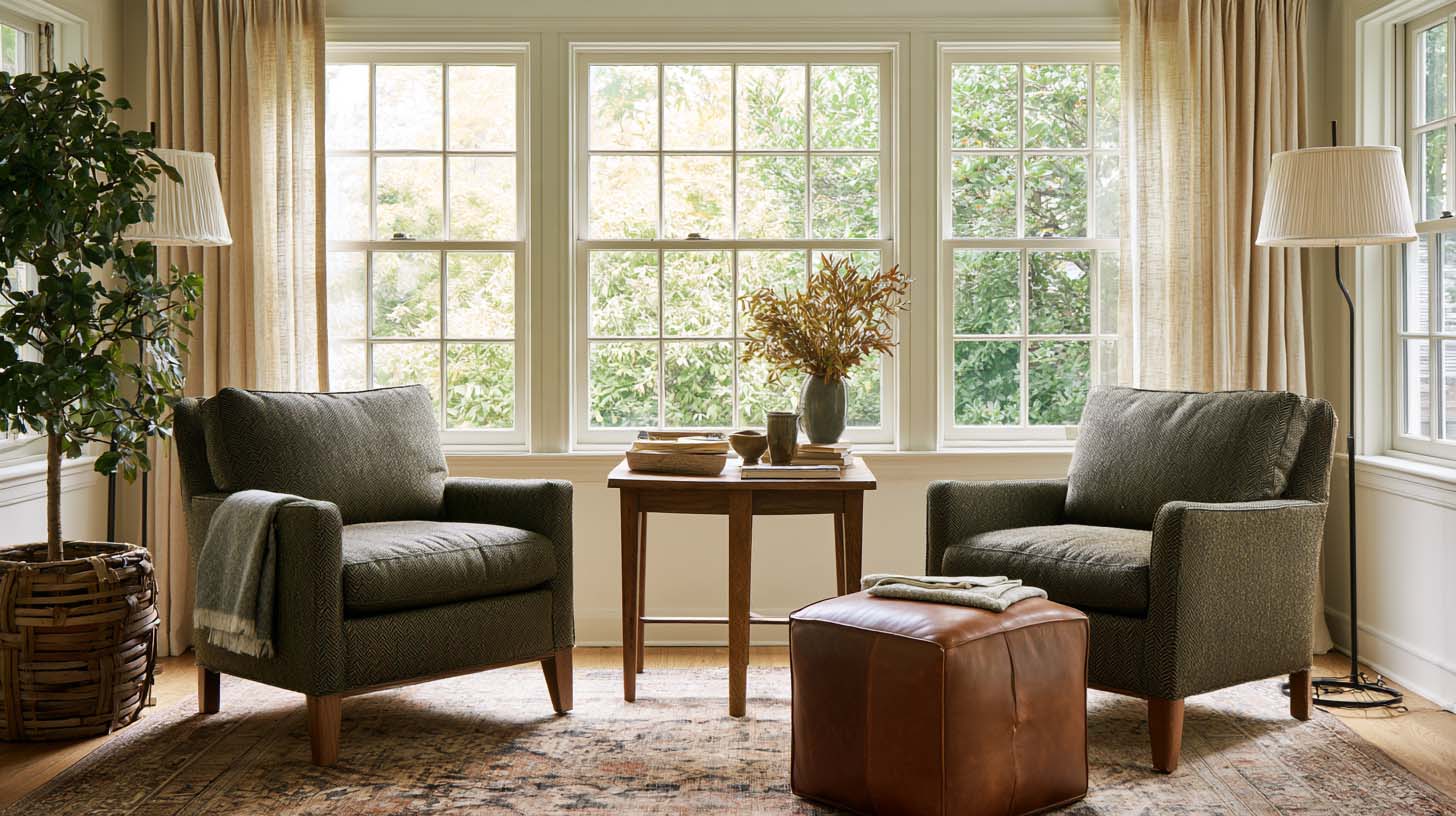
If leather is the fabric most associated with masculine interiors, wool may be the one that deserves more attention. It can be smooth, nubby, flannel-like, felted, tweeded, boucle, herringbone, plaid, heavy, or fine. That range allows wool to move between traditional and contemporary interiors easily. A charcoal wool on a clean-lined sofa can feel architectural. A brown herringbone on a club chair feels tailored. Cream boucle can soften a modern masculine room without making it visually delicate, and olive wool curtains can introduce substantial color and drape.
The International Wool Textile Organisation identifies wool as particularly suitable for interior applications including carpets and upholstery because of its durability, comfort, resilience, and aesthetic qualities. Its natural fire resistance also explains wool's long use in furnishings, curtains, bedding, and carpets. This makes wool one of the most versatile foundations for a masculine textile scheme.
Tweed Gives a Room Tailoring
Tweed is not a fiber so much as a family of woven woolen fabrics, and visually it brings something unusually useful to interiors: small-scale complexity. Several yarn colors may combine into a surface that reads as one color from across the room, brown might contain black, cream, rust, and olive, gray might include charcoal, blue, and oatmeal. That makes tweed easier to coordinate than its close-up appearance suggests. It works particularly well on reading chairs, desk chairs, benches, small sofas, ottomans, and headboards. There is also a cultural association with tailored clothing, country houses, sporting life, and traditional menswear, one the textile already carries quietly.
Herringbone Gives You Pattern Without Busyness
Herringbone deserves separate mention because it sits somewhere between pattern and texture. From across a room, a fine brown herringbone may appear almost solid. Walk closer and the diagonal weave becomes visible. This makes it particularly useful when another element, perhaps a Persian rug or patterned curtain, is already carrying more obvious pattern. A herringbone chair beside a patterned rug rarely feels like two patterns. One announces itself. The other reveals itself.
Linen Makes Heavy Rooms Breathe
Linen performs almost the opposite job from leather. Where leather adds visual weight, linen often provides relief. This is why it works beautifully in rooms containing substantial wood, stone, dark paint, or leather furniture: warm ivory linen curtains against forest-green walls, a natural linen chair beside a walnut desk, linen shades on bronze lamps, a linen-covered headboard in a bedroom full of dark wood.
The weave has visible irregularity, which keeps large expanses of plain fabric from looking sterile, and its relaxed drape prevents formal rooms from becoming too stiff. Linen can wrinkle, and that is not necessarily a defect. If you expect the surface to remain perfectly smooth, another textile may be better. If you appreciate the slight irregularity, linen brings something synthetic perfection cannot reproduce.
Velvet Is About Light as Much as Softness
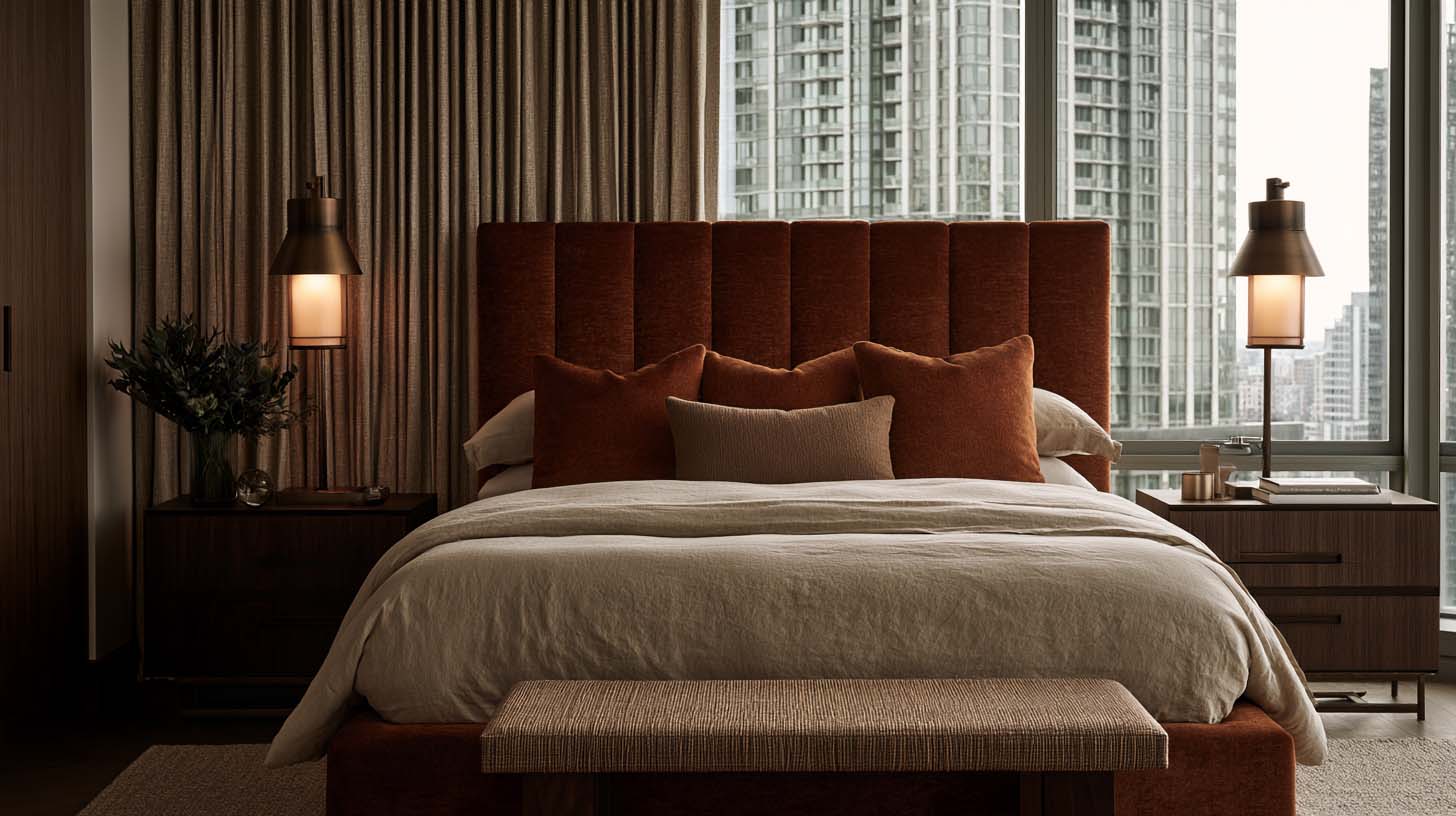
Velvet has pile, which means its appearance changes as light moves across the surface. A deep green velvet chair may look almost black in one direction and noticeably greener in another. Rust velvet can glow under warm lamplight, and brown velvet develops highlights that a flat-weave brown fabric does not.
This makes velvet useful in masculine interiors where the palette is restrained but the room still needs richness. It does not need to be formal. The furniture silhouette changes the effect dramatically: a tufted burgundy velvet sofa can feel traditional, a clean-lined tobacco velvet chair can feel contemporary, and a dark olive velvet bench may feel almost architectural.
Mohair Brings Quiet Luxury
Mohair upholstery deserves more attention because it combines visual softness with surprising resilience. Mohair comes from the Angora goat and is known for its luster, durability, elasticity, and ability to take color, a resilient luxury fiber used in interiors as well as fashion, with a smooth surface that reflects color particularly well.
In a room, mohair can look almost like velvet from a distance, but it has its own character: a tobacco mohair chair, a deep-blue mohair sofa, an olive lounge chair, a rust bench. These can feel luxurious without looking shiny or overtly decorative, and mohair is particularly effective when you want upholstery to feel special while remaining visually restrained.
Cotton Is Useful Precisely Because It Can Be Ordinary
Not every textile should announce its quality. Cotton can be extremely useful for slipcovers, printed fabrics, checks, stripes, casual upholstery, bedding, and curtains. The material often reads as familiar and relaxed, which makes it a good counterpoint to expensive or formal materials. A room containing walnut, bronze, wool, and stone may benefit from a simple cotton stripe precisely because it prevents everything from feeling precious. Luxury does not require every surface to be luxurious. Sometimes an ordinary material used appropriately gives the expensive materials more credibility.
Suede Changes the Surface Without Adding Pattern
Suede and suede-like textiles introduce a soft matte surface, which can be valuable in rooms already containing polished stone, leather, glass, or metal. The visual effect is quieter than leather. Camel, tobacco, chocolate, olive, and taupe suede can all work beautifully in masculine interiors, but application matters: natural suede has different maintenance characteristics from protected performance textiles designed to imitate its hand. If the chair will receive constant family use, evaluate the actual fabric's durability and care requirements rather than buying based on appearance alone.
Leather Should Not Carry the Entire Textile Scheme
Leather is excellent precisely because it is unlike fabric: smooth beside nubby wool, slight sheen beside matte linen, aged beside crisp cotton, dense beside soft velvet. That contrast disappears when every upholstered piece is leather. A cognac sofa with wool chairs may look richer than a cognac sofa with matching leather chairs, and an old leather desk chair against linen curtains and a wool rug feels more distinctive because the leather occupies a minority position.
Weight, Texture, and Restraint Matter More Than Any Single Fabric
A common fabric mistake is choosing several textiles with different colors but almost identical visual weight: a smooth sofa, smooth chairs, smooth curtains, smooth pillows. Everything remains flat despite the palette changing. Instead, think heavy against light, coarse against fine, matte against slight sheen, pile against flat weave, structured against relaxed. This creates depth without needing more decoration.
Designer Eyes: Turn the fabric samples sideways
The face of a sample tells only part of the story. Turn several fabrics sideways under the same light: velvet and mohair reveal pile, linen shows irregularity, tweed reveals thickness, and a flat synthetic weave may suddenly look much less interesting. You are not merely choosing color, you are choosing a surface.
Texture can also separate similar colors. Suppose a room is largely brown: a walnut table, chocolate sofa, tobacco chair, brown curtains. This could become muddy. But if those browns appear through different materials, polished walnut, matte wool, leather, linen, the eye can still separate them. This is one reason sophisticated monochromatic rooms rarely rely on one material.
This may be the most useful rule of all: not every textile in the room needs to be "masculine." If the sofa is dark wool, the rug is Persian, the chair is leather, and the walls are olive, the curtains do not need another masculine signal. They can simply be warm ivory linen. Masculinity emerges from the composition. It does not need to be encoded into every fiber.
The TMH Perspective
In our design work, textiles often become the point where an otherwise competent room either develops depth or stays strangely flat. The furniture may already be right. What changes the room is replacing one more smooth gray fabric with a brown herringbone wool, introducing linen curtains, putting a mohair chair beside leather, or letting a Persian rug supply color beneath simple upholstery. These are not dramatic changes. That is precisely why they work. A sophisticated textile scheme is rarely asking you to notice the fabric first. It makes the entire room feel better before you quite understand why.
If your furniture selections are individually good but the room still feels flat, TMH's Full-Service Interior Design can develop the larger relationship among color, material, texture, furniture, and pattern rather than treating each fabric as an isolated choice.
Frequently Asked Questions
What fabrics make an interior feel masculine?
Wool, linen, tweed, leather, mohair, velvet, suede, cotton, and canvas can all work. The masculine quality usually comes from the combination of weight, texture, color, furniture form, and surrounding materials rather than the fiber alone.
What is the best masculine upholstery fabric for a sofa?
There is no universal best choice. Wool is exceptionally versatile, linen can suit lighter rooms, mohair offers a refined pile, and leather works where visible aging and smooth texture are desirable. Choose according to use as well as appearance.
Can velvet work in a masculine room?
Absolutely. Tobacco, olive, rust, navy, brown, charcoal, and even cream velvet can work particularly well. Clean furniture silhouettes prevent velvet from automatically becoming formal.
Should all fabrics in a room match?
No. In fact, mixing fabric types usually creates more depth. A wool sofa, leather chair, linen curtains, and patterned rug can be more sophisticated than matching upholstery across every piece.

Facebook
Instagram
Youtube