Masculine Bed Ideas: Design the Room Around the Bed
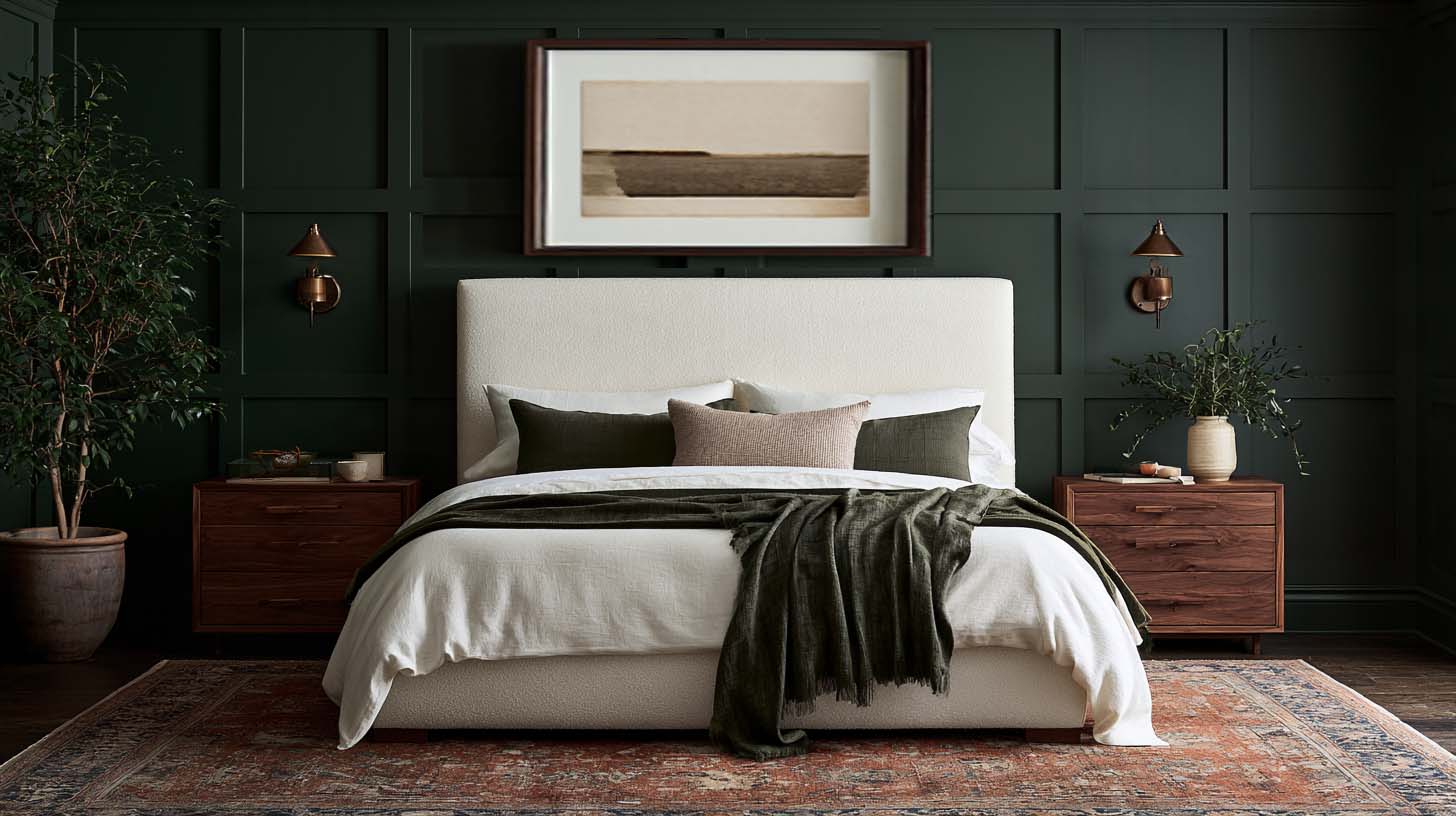
The bed should be the strongest piece of furniture in the bedroom.
That sounds obvious, but many rooms are designed as though the bed were simply another object placed against the wall.
A low mattress. A timid headboard. Tiny nightstands. Small lamps. A rug that barely reaches beyond the frame.
Then we try to recover the room with art, paint, pillows, or another chair in the corner.
The problem is usually more basic. The bed never established enough authority.
Good masculine bed ideas begin by treating the bed as the architectural anchor of the room. Its width, height, material, upholstery, frame, and relationship to the wall determine how nearly everything else should behave.
Get that right and the bedroom becomes easier to finish. If you are not sure whether your own bed is the piece holding the room back, a Room Audit is a fast way to get an outside opinion.
Start With the Bed Before Decorating the Wall
The wall behind the bed is usually the most important elevation in the room.
That means the bed and wall should be considered together.
Look at wall width, ceiling height, window placement, nightstand width, lamp or sconce placement, artwork, molding or paneling, and bed width and headboard height.
A bed that looks substantial in a showroom can seem strangely small when placed against a 16-foot wall beneath a 10-foot ceiling.
The opposite happens in compact bedrooms. A massive bed frame with thick rails and an oversized headboard can consume the architecture before nightstands even arrive.
The goal is not simply to buy a large bed. It is to give the bed enough visual weight for the room it occupies.
An Under-Scaled Bed Weakens Everything Around It
This is one of the most common bedroom problems we see.
The room contains a king mattress, but the frame itself has almost no architectural presence.
Perhaps the headboard rises only a few inches beyond the pillows. Perhaps there is no headboard at all.
Now the nightstands appear disproportionately large. Lamps seem taller. Artwork floats. The wall above the bed feels unfinished.
The temptation is to keep adding.
Often the simpler fix is improving the bed itself. A stronger headboard can reorganize the entire elevation without adding another decorative object.
Designer Eyes: Ignore the Bedding
When evaluating a bed, mentally remove every pillow, throw, and duvet. What is left? Does the frame still hold the wall? Is the headboard substantial enough? Does the silhouette have character? A good bed should not require styling to establish its presence.
Upholstered Beds Bring Softness Without Weakness
Upholstered beds are particularly useful in masculine bedrooms because they give you scale without introducing another hard material.
If the room already contains wood floors, wood nightstands, a dresser, metal lighting, and perhaps a leather chair, another large wooden bed can make the room overly hard.
An upholstered headboard changes the balance.
Wool. Linen. Mohair. Velvet. Textured performance fabric. These can all work.
The shape matters just as much as the textile.
A tall rectangular headboard feels architectural. A gently curved headboard introduces softness. A winged headboard adds enclosure. Channeling or restrained tufting can add detail, though it should not become decorative noise.
Wood Beds Add Permanence
A good wood bed can become one of the strongest objects in the room.
Walnut tends to feel refined and warm. Oak can move contemporary or rustic depending on grain, finish, and construction. Mahogany feels more formal. Painted wood can work beautifully in traditional rooms.
A substantial wood headboard is particularly convincing when the bedroom needs more architecture.
But pay attention to repetition. Walnut bed. Walnut nightstands. Walnut dresser. Walnut bench. The room can begin looking like a furniture suite.
Consider contrast. A walnut bed with painted nightstands. Dark oak bed with bronze tables. Wood bed beside fabric seating.
A collected bedroom rarely requires every case piece to match.
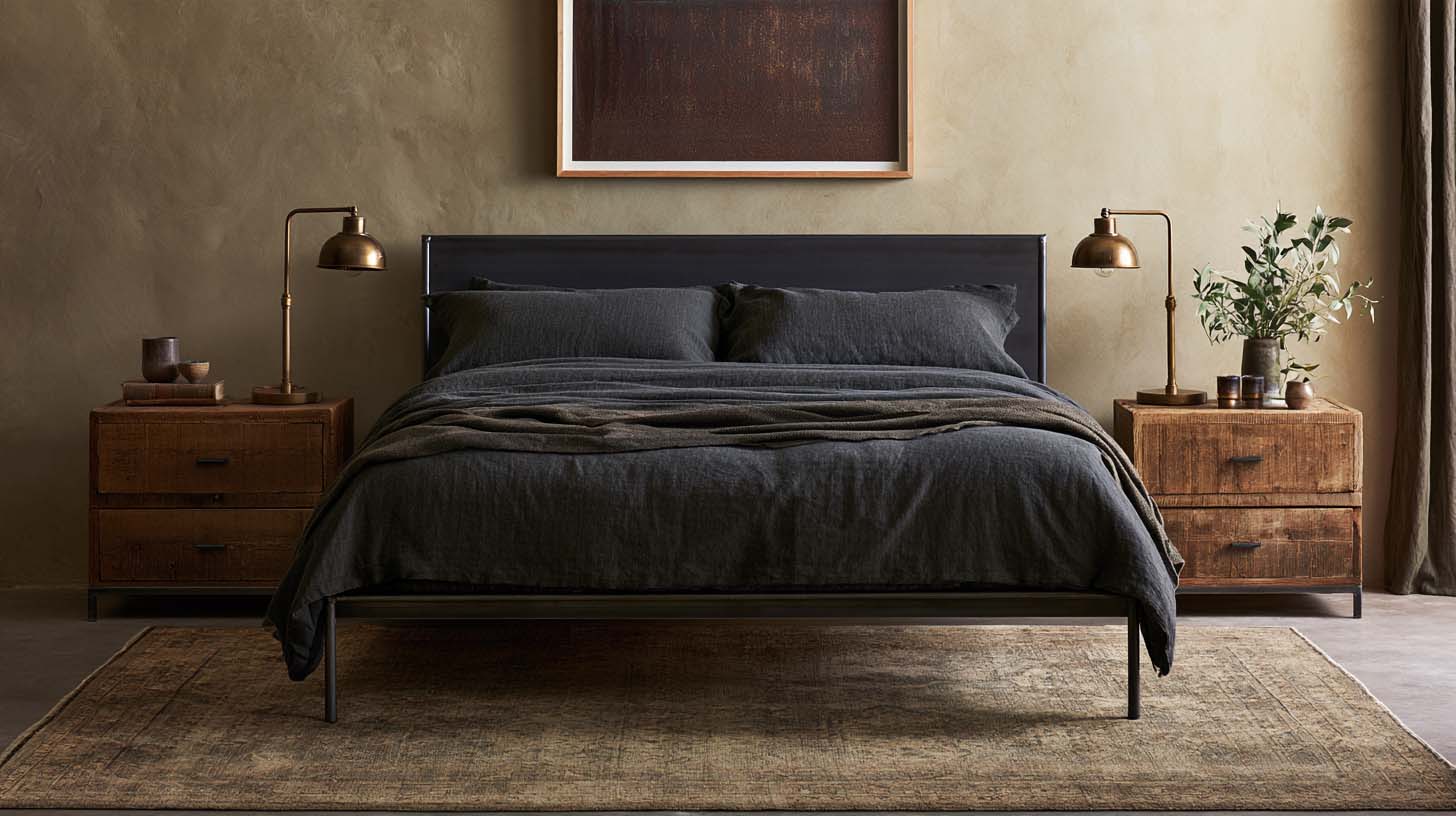
Metal Beds Are Better Than Their Reputation
Metal beds can work very well in masculine interiors.
The wrong version may feel flimsy. The right one can feel spare, historical, or architectural.
Iron. Blackened steel. Bronze-toned metal. Simple spindle forms. Campaign-influenced frames.
Metal becomes especially useful when the room already contains a great deal of wood.
A dark metal bed against plaster walls with wool bedding and an antique rug can feel far richer than another wood-on-wood composition.
The key is substantial construction and a silhouette appropriate to the architecture.
Headboard Height Should Respond to the Wall
There is no universal correct headboard height.
A tall bedroom with generous wall space can support more verticality. A room with a low ceiling may look better with something quieter.
Pillow height matters too. Once bedding is installed, a headboard that looked adequate in an empty showroom can disappear behind stacked pillows.
This is why we prefer considering the complete bed elevation at once. Mattress. Frame. Headboard. Pillows. Wall. Artwork. Nightstands.
The headboard needs enough visible area to remain a real design element.
Avoid Headboards That Become Wall Art
There is another extreme.
Huge geometric panel systems. Massive upholstered walls. Integrated LEDs. Headboards stretching the entire wall.
These can work in highly architectural contemporary bedrooms.
But they can also turn the bed into a design installation.
Ask whether the architecture actually supports the gesture.
A strong headboard should anchor the room. It does not always need to consume it.
Beds for Men Do Not Need to Look Rugged
There is an unfortunate assumption that beds for men should be dark, chunky, leather, industrial, reclaimed, or black metal.
That is a very narrow interpretation.
A warm ivory upholstered bed can feel deeply masculine beside walnut, bronze, dark artwork, and a rust rug.
A simple pale oak bed can work in a Dark Scandinavian room.
A tailored deep-blue wool headboard can feel more masculine than distressed brown leather because its proportions are better.
The room creates the identity. Not the catalog category.
Nightstands Need Enough Scale
Small nightstands beside a large bed make the bed look awkwardly oversized.
They also tend not to function well.
There should be enough surface for a lamp, a book, a phone, water, glasses, or whatever you actually use.
Drawers or doors may be useful if clutter needs to disappear.
For a king bed, particularly in a larger room, narrow 18-inch bedside tables can look noticeably under-scaled.
The exact dimensions depend on the architecture, but visually the nightstands should feel substantial enough to belong beside the bed.
Matching Nightstands Are Optional
Symmetry is powerful in bedrooms because the bed itself is symmetrical.
Matching nightstands reinforce that. There is nothing wrong with the approach.
But they do not need to come from the same furniture set as the bed.
An upholstered bed with matching walnut nightstands. A wood bed with painted chests. A dark metal bed with antique bedside cabinets.
The strongest relationship often comes from proportion and color rather than identical manufacture.
Lamps Need to Relate to the Headboard
Tiny bedside lamps are one of the fastest ways to make a substantial bed look awkward.
Look at lamp height, shade width, and the visual weight of the base.
A wide upholstered headboard may benefit from larger lamps. A more delicate metal bed may suit something lighter.
Sconces can free nightstand space and create a more architectural elevation.
But placement should respond to actual reading height rather than being installed wherever the drawing looked symmetrical.
Artwork Above the Bed Should Not Compete With the Headboard
If the headboard already has substantial height, artwork may be unnecessary.
This is worth saying because bedroom design often assumes something must occupy the wall above the bed.
Sometimes the headboard is enough.
If art is used, scale it to the bed rather than selecting a small piece simply because it fits within the remaining wall.
One broad work. A triptych. A restrained grouping. Or nothing.
The correct choice depends on how much visual information already exists.
The Rug Should Support the Bed, Not Peek Out Beneath It
An under-scaled rug makes the entire bed composition feel weaker.
The rug should extend enough beyond the sides and foot of the bed to become visible and useful.
The exact arrangement depends on room size and rug dimensions.
Common approaches include a large rug under most of the bed, a rug beginning ahead of the nightstands and extending beyond the foot, or two runners where a full rug is impractical.
But the principle is always the same. The rug should look like it belongs to the bed rather than being trapped underneath it.
A Bench Can Extend the Bed's Architecture
A bench at the foot of the bed can be extremely useful.
It adds another material, a place to sit, a place to set clothing temporarily, and a visual endpoint.
But it needs enough width to relate to the bed.
A tiny bench against a king bed looks like an afterthought.
Material contrast works well. Wood bed plus upholstered bench. Upholstered bed plus wood bench. Simple bed plus vintage chest.
Do not add one solely because bedrooms are supposed to have them. If circulation is tight, leave it out.
The Mattress Height Changes the Composition
Today's mattresses and foundations can become very tall.
That affects headboard visibility, nightstand height, bench height, ease of getting in and out, and overall visual weight.
Before ordering the frame, understand how high the finished sleep surface will sit.
A beautifully proportioned bed can become awkward when a very thick mattress hides much of the headboard or sits unusually high relative to the nightstands.
This is another example of why individual furniture dimensions are less useful than the completed relationship.
The Bed Can Set the Style Without Defining Everything
A traditional bed does not require an entirely traditional bedroom.
A walnut four-poster can sit beside simpler modern lamps. A contemporary upholstered bed can work with antique nightstands. A metal bed can sit on a Persian rug.
Historical bed design itself has always been far more diverse than the modern bed frame category suggests, including multifunctional storage beds and later upholstered and imitation-bamboo frames from earlier centuries.
The lesson is useful. The bed has always been capable of being a major piece of furniture. Treat it like one.
Keep the Bed Wall Quieter if the Bedding Is Strong
Patterned quilt. Plaid blanket. Striped sheets. Textured headboard. Bold rug. Dark wall. Artwork.
At some point, the bed becomes difficult to read.
If the textiles are active, the architecture may need to become calmer.
If the wall and headboard are simple, bedding can carry more pattern.
Hierarchy matters here as much as in any other room.
The TMH Perspective
A masculine bedroom rarely becomes convincing because of more decoration.
It becomes convincing when the bed stops looking temporary.
A proper frame. A headboard with enough height. Nightstands with enough mass. Lighting at the right scale. A rug that establishes territory. Bedding that supports rather than obscures the structure.
In our design work, strengthening the bed elevation often does more than adding another chair, another piece of wall art, or another layer of styling.
The bed is the room. Start there.
If your bedroom has good individual pieces but still feels underwhelming, TMH's Full-Service Interior Design can develop the bed, headboard, nightstands, rug, lighting, and art as one composition, so you are not replacing furniture one piece at a time.
Frequently Asked Questions
What type of bed looks most masculine?
Upholstered, wood, and metal beds can all feel masculine. Scale, headboard height, material, color, and surrounding furniture matter more than any single bed style.
How tall should a masculine headboard be?
There is no universal height. It should remain visually substantial after the mattress and pillows are installed and should relate appropriately to the wall and ceiling height.
Should a masculine bed frame be dark?
No. Warm ivory upholstery, medium oak, walnut, painted wood, bronze-toned metal, and many lighter finishes can all work.
Should nightstands match the bed?
Not necessarily. Matching nightstands can create symmetry, but contrasting materials often make the bedroom feel more collected.

Facebook
Instagram
Youtube