Modern Masculine Interior Design Without the Cold Minimalism
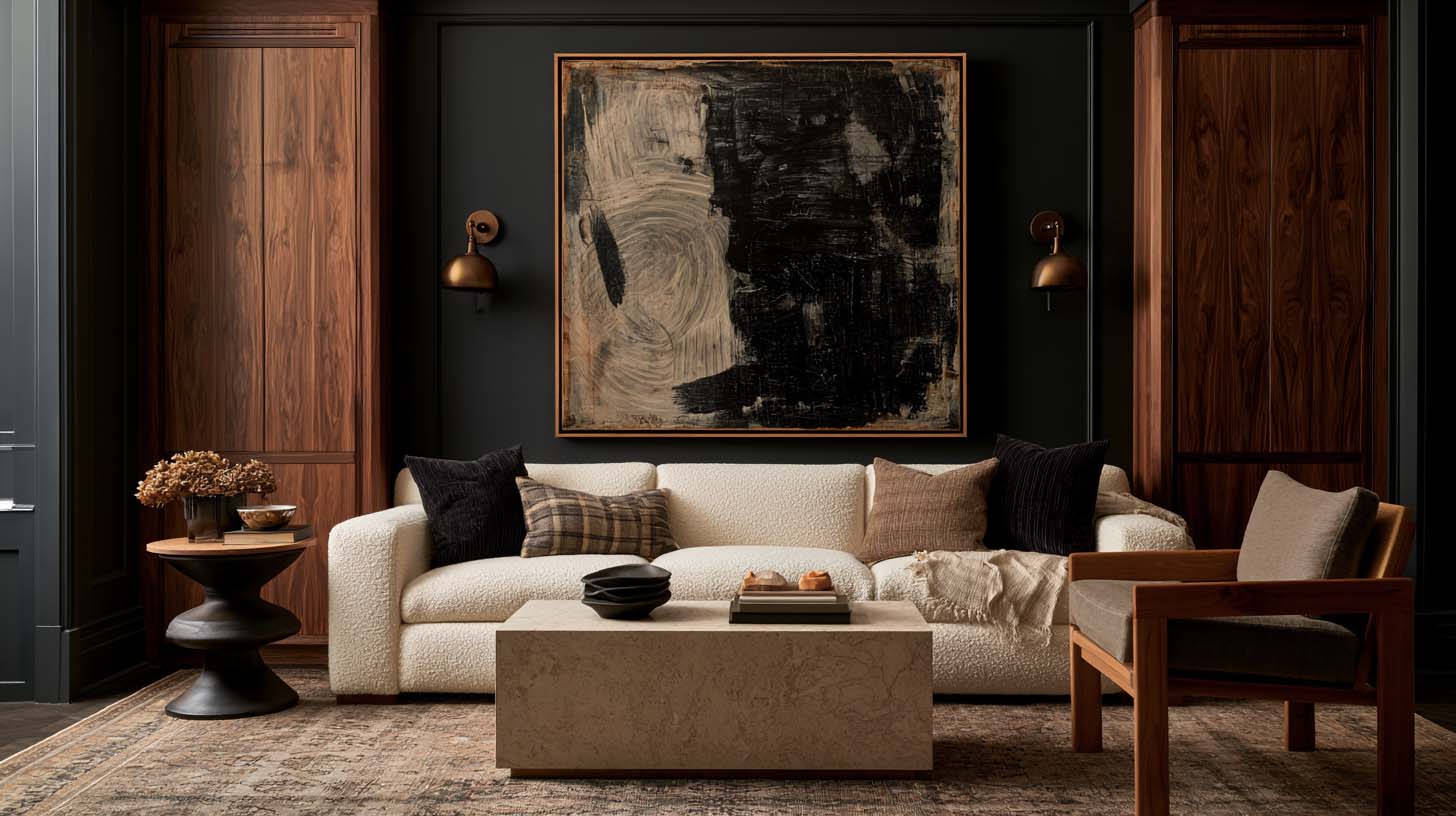
Modern masculine interiors often fail in the same way. They become exceptionally good at removing things. Decoration disappears. Color disappears. Curtains disappear. Visible storage disappears. Furniture becomes lower, straighter, cleaner, and increasingly neutral. Eventually the room has achieved impressive visual discipline, and very little reason to spend time in it.
That is not the only way modern masculine interior design can work. A room can have clean lines and still feel warm. If you want an outside read on where your own room currently sits, a Room Audit is a fast way to get one.
Furniture can be contemporary without looking insubstantial. A restrained palette can contain depth. Stone, wood, wool, leather, plaster, art, and older objects can coexist comfortably with modern architecture. The objective is not to soften modern design until it becomes traditional. It is to give it enough material, texture, and personality to feel inhabited.
Modern Does Not Mean Minimal
These terms are often treated as synonyms, but they describe different things. Modern and contemporary interiors may use clean lines, open plans, simple geometry, and reduced ornament. Minimalism pushes further toward reduction. Architectural Digest's current overview of contemporary design identifies clean lines, natural materials, neutral palettes, geometric forms, soft textiles, metal, wood, and layered texture among the style's recurring elements, and notes that many successful contemporary interiors mix modern pieces with older objects and artwork rather than remaining stylistically pure. (Architectural Digest)
That distinction gives masculine rooms considerable freedom. You can have a clean-lined sofa, contemporary lighting, and simple cabinetry without making the room empty. You can collect art, own books, use an old rug, hang curtains, and display something inherited. Modern design determines the language. It does not determine how little life the room is allowed to contain.
Give Clean Furniture Enough Mass
Contemporary furniture sometimes becomes visually weak because designers pursue lightness too aggressively: thin legs, thin tops, low profiles, floating bases, narrow arms. Everything seems designed to disappear.
A masculine modern room usually needs at least some pieces that do the opposite: a broad sofa, a monolithic stone coffee table, a thick oak dining table, a substantial upholstered bed, a large cabinet, a deep lounge chair. What matters is that they have enough scale and visual weight to anchor the room. This is the contemporary equivalent of a traditional masculine interior's heavy desk or wing chair. You are not reproducing the shape. You are preserving the presence.
Use Wood Before You Reach for More Black
Modern masculine rooms frequently overuse black: black windows, black cabinets, black metal tables, black lamps, black frames, black hardware, black fixtures. Individually, each choice may work. Together, they can reduce the entire room to outline and contrast.
Wood introduces complexity that black cannot. Smoked oak can feel architectural. Walnut creates depth and warmth. Natural oak works beautifully in lighter modern rooms. Medium brown wood can ground gray stone. Wood also changes through grain and light. The surface does not read as one flat color. If a modern room feels cold, adding another black object is rarely the answer. Adding one substantial wood element often is.
Natural Materials Prevent Sterility
Modern interiors are particularly sensitive to material quality because simple forms leave fewer places for weak materials to hide. A plain stone table asks you to look at the stone. A simple oak cabinet asks you to notice grain. A linen curtain depends on texture. A wool sofa depends on hand and tailoring.
Architectural Digest designers routinely cite natural materials and layered textures as ways to add warmth to streamlined spaces, and recent projects combine wood, stone, soft textiles, vintage pieces, and art specifically to prevent modern rooms from feeling sterile. (Architectural Digest) Use walnut, oak, limestone, travertine, marble, plaster, wool, linen, mohair, leather, bronze, and ceramic. A restrained palette becomes far more interesting when every material behaves differently.
Texture Is the Modern Room's Ornament
Traditional rooms can create interest through carving, molding, pattern, trim, furniture detail, and ornament. Modern rooms remove much of that. Something needs to replace it. Texture often does: wool, mohair, heavy linen, woven rugs, plaster, honed stone, grainy wood, leather, ceramic, and brushed metal all prevent simple rooms from becoming visually flat.
One of Architectural Digest's design features describes texture as a way to make polished rooms feel more approachable and lived in, particularly where clean lines and smooth surfaces otherwise create sterility. (Architectural Digest) The masculine version does not need to become overly soft. It needs material contrast: smooth stone beside wool, walnut beside linen, leather beside plaster, bronze beside oak. That is enough.
Warm Neutral Does Not Mean Beige Everywhere
The modern masculine palette has acquired another cliché: beige. Cream sofa, travertine table, taupe rug, mushroom wall, tan chair. The room is warm in theory but may still feel anonymous because everything occupies the same middle value.
A strong contemporary masculine interior needs contrast. Consider combinations such as cream with walnut and blackened bronze, warm gray with cognac and oak, stone with oxblood and smoked wood, taupe with olive and dark brown, white plaster with tobacco leather and bronze, or muted blue with travertine and walnut. The palette can remain restrained while still containing moments of depth.
Designer Eyes: Look at the Room in Black and White
Take a photograph of the room and turn it to black and white. If everything collapses into the same middle gray, the problem is not color. It is value. A convincing modern room still has a few true darks, a few clean lights, and a range in between. Walnut, bronze, a deep rug, or a dark painting will often do what another beige accessory cannot.
Let Stone Feel Geological
Stone is often used in modern luxury interiors because it communicates cost and permanence. It can also make a room feel cold when polished heavily or repeated everywhere. Choose stone for character rather than status: veining, fossils, texture, variation, honed finishes, and irregular edges where appropriate.
Soapstone, travertine, limestone, marble, quartzite, and other stones each communicate differently. A large stone table is visually powerful because the material itself carries weight. That is enough. You do not need stone on the fireplace, side tables, console, lamp bases, and decorative objects too. One convincing application usually has more authority than repeated luxury signaling.
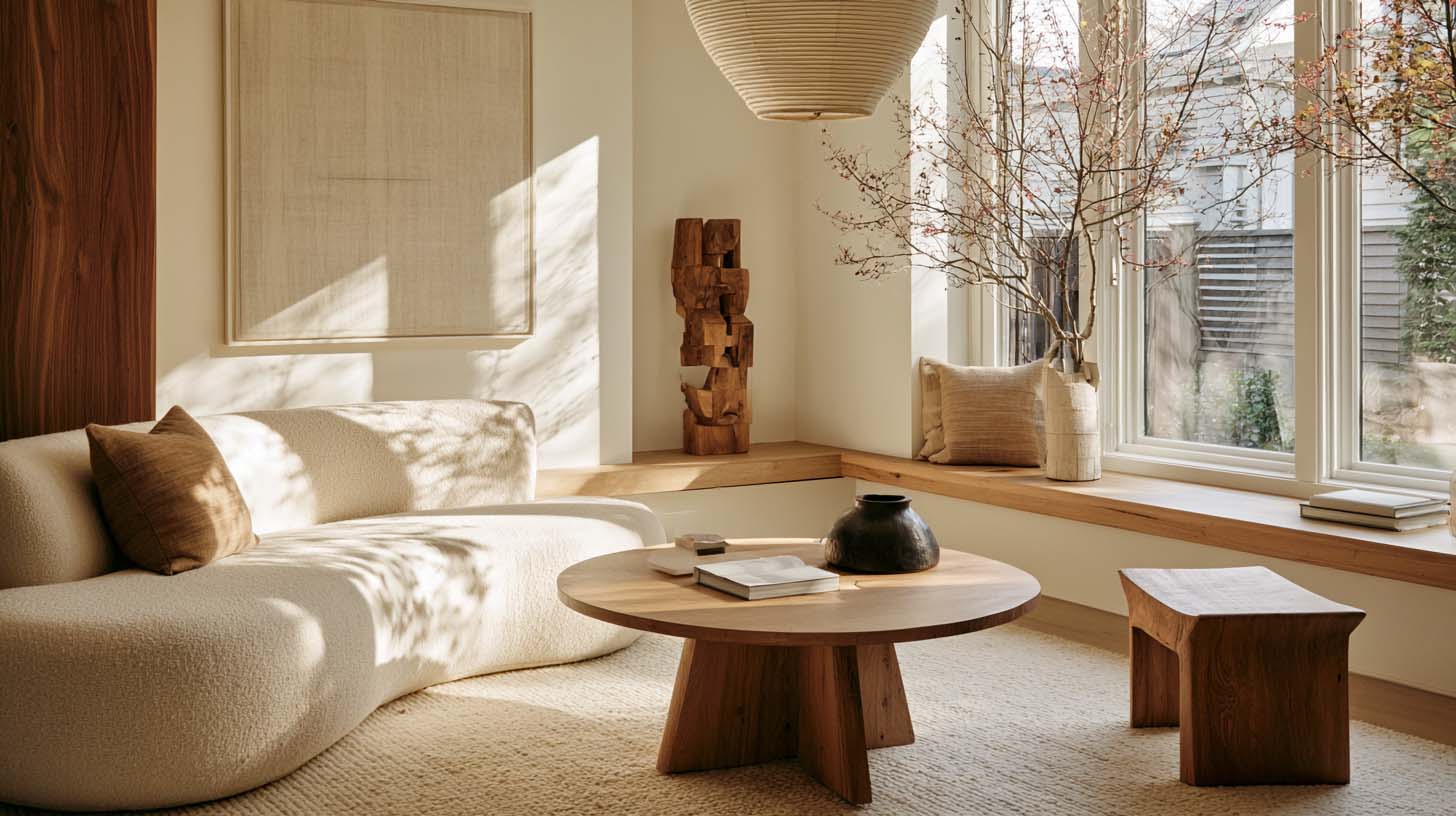
Add Curves to Straight Architecture
Modern interiors often contain many rectangles: rectangular room, rectangular windows, rectangular sofa, rectangular coffee table, rectangular rug, rectangular artwork, rectangular cabinetry. Eventually the room begins to feel diagrammatic.
Curves interrupt the geometry: a barrel chair, a round side table, a sculptural lamp, a curved sofa, a ceramic vessel, a circular dining table, an arched mirror. Recent modern interiors frequently use curved or organic furniture forms against linear architecture precisely because the contrast keeps the composition from becoming rigid. (Architectural Digest) You do not need curves everywhere. One is often enough to remind the room that people are not rectangles.
Use Art as a Major Design Element
Modern rooms are excellent settings for artwork because architectural simplicity gives art visual room. That should encourage you to buy better art, not generic art. One substantial painting can carry an entire wall. Large photography may establish the room's strongest contrast. A sculpture can become more important because there are fewer competing objects.
Even a restrained gallery arrangement can work if the room has enough negative space around it. Do not choose artwork simply to introduce a matching accent color. Let the work have independence. This is often where contemporary masculine interiors acquire personality.
Add Something Old
One antique can transform a modern room because it introduces a quality contemporary furniture cannot manufacture instantly: time. An old chest beneath modern art. A vintage chair beside a simple sofa. A faded rug beneath a stone table. An antique lamp on contemporary cabinetry.
The effect is not eclecticism for its own sake. It is contrast. New becomes visibly new because something older sits beside it. Perfect surfaces become less precious. The room gains chronology.
Rugs Should Ground, Not Merely Soften
Modern interiors frequently use large expanses of hard flooring. A rug becomes especially important because it gives the furniture a territory. The mistake is choosing a pale rug so visually quiet that it contributes almost nothing.
A faded Persian rug can work beautifully beneath modern furniture. So can a deeply textured wool solid. A graphic geometric rug may suit stronger architecture. Natural fiber works in the right context. The rug can bring warmth without forcing the furniture itself to become traditional. It is often one of the easiest ways to add history or pattern to a room otherwise governed by simple forms.
Do Not Leave the Windows Bare by Default
Bare glass can look architecturally clean in photographs. It can also make a room feel exposed, acoustically hard, and incomplete. Modern curtains do not need elaborate headers, trim, tiebacks, or decorative rods.
A simple full-height linen treatment can disappear into the architecture while still adding softness. Wool drapery can create greater weight. Sheers can diffuse harsh light while preserving openness. The objective is not decorating the windows. It is controlling light and introducing another material plane.
Layer the Lighting
Modern interiors frequently rely on architectural lighting: recessed fixtures, linear LEDs, integrated cabinetry lights, and track systems. These can be excellent. They are not enough. A room also needs light at human height: table lamps, floor lamps, sconces, reading lights, a sculptural pendant, and picture lights where appropriate.
This introduces warmth and changes how the room feels after sunset. Architectural light defines the room. Lamps make it inhabitable. The distinction becomes especially important in modern masculine rooms containing stone, glass, plaster, and metal, where overhead light can emphasize hardness.
Collections Can Belong in Modern Rooms
Minimalism has created the impression that contemporary interiors are incompatible with collections. They are not. The display simply needs stronger editing. Rather than scattering objects across every surface, concentrate them: one long shelf, a cabinet, a table, a single wall, books grouped in a substantial bookcase, or photography presented as a coherent series.
The cleaner the architecture, the more visibly deliberate the collection becomes. Modern design does not eliminate biography. It gives biography a clearer background.
Technology Should Disappear Into the Hierarchy
Modern masculine homes often contain more technology than traditional ones because the visual language readily accommodates screens, speakers, smart-home systems, and contemporary equipment. That does not mean those things should become the dominant decorative language.
Integrate them. Conceal wires. Design cabinetry around equipment. Avoid letting several unrelated black rectangles become the room's primary visual motif. The strongest modern room still gives priority to furniture, material, art, architecture, and human use. Technology should work beautifully. It does not need to be the most beautiful thing in the room.
Modern Masculinity Is More About Restraint Than Severity
This distinction matters. Restraint means choosing selectively. Severity means stripping away comfort. A restrained room may contain only one large artwork instead of five. A severe room may contain none. A restrained sofa may have a simple silhouette. A severe sofa may sacrifice comfort to look architectural.
A restrained palette may use four materials carefully. A severe one may eliminate variation altogether. Masculinity does not require austerity. Confidence often appears through knowing when enough has been achieved.
The TMH Perspective
The most common failure we see in modern masculine rooms is not that they are too contemporary. It is that the owner has confused cohesion with sameness. Every piece becomes straight-lined. Every material becomes neutral. Every metal becomes black. Every textile becomes solid. Every object becomes minimal. The room is consistent, but nothing has anything to react against.
The fix is usually contrast: an antique, a curved chair, a warm wood, a patterned rug, a large painting, or a softer curtain. One of those decisions may do more than ten additional pieces of contemporary furniture. If your modern interior looks clean but still feels impersonal, TMH's Full-Service Interior Design can develop a warmer contemporary direction through furniture scale, natural materials, texture, lighting, art, and collected details without abandoning the architecture that attracted you to modern design in the first place.
Frequently Asked Questions
Can a modern masculine room use color, or does it need to stay neutral?
It can use color. The key is control rather than avoidance, a muted blue, deep olive, or oxblood accent can work well against a mostly neutral, material-driven palette.
Is black hardware and metal a mistake in modern masculine design?
Not on its own, but relying on it exclusively can flatten a room. Mixing in aged brass, bronze, or warm wood keeps black metal from becoming the room's only visual language.
Do modern masculine rooms need curtains if the architecture is already clean?
Yes, in most cases. Bare windows tend to make a room feel exposed and acoustically hard regardless of how clean the architecture is. A simple linen or wool treatment solves this without adding visual clutter.
How do you keep a modern room from feeling sterile without adding clutter?
Texture and one or two aged or curved objects usually do more than additional furniture. A textured rug, a substantial stone table, or a single antique can add depth without crowding the room.

Facebook
Instagram
Youtube