How to Choose Artwork for a Masculine Interior
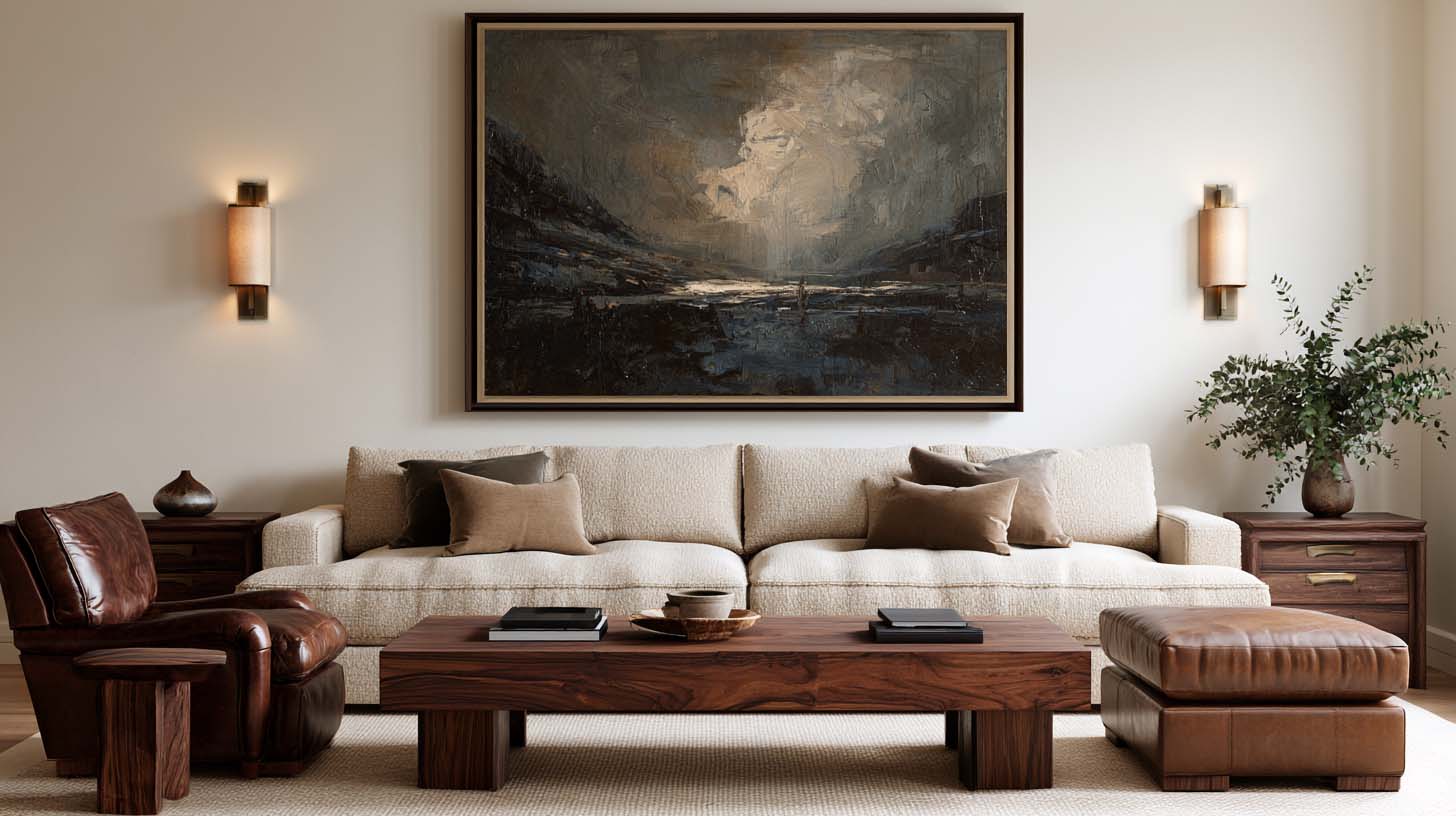
The easiest way to choose bad art for a masculine room is to begin by searching for masculine wall art. That search tends to produce a predictable visual universe: cars, whiskey, lions, skylines, maps, black-and-white photographs, abstract prints in charcoal and gold.
Some of those subjects can absolutely belong in a man's home. But the strongest artwork does something more interesting than verify that the owner is male. It gives you something worth looking at. If your walls need something but everything you find still feels generic, a Room Audit can help identify whether the issue is really about art or about the room itself.
Choosing masculine artwork therefore has less to do with finding imagery traditionally associated with men and more to do with developing taste: noticing what holds your attention, learning what different media feel like in a room, understanding scale, and buying pieces that acquire meaning because you chose them deliberately. You do not need to become an art historian. You need to learn how to look.
Start With Your Reaction Before Your Room
When people feel uncertain about art, they often begin with the furniture. The sofa is brown. The rug has burgundy. The walls are cream. Therefore, the painting should contain brown, burgundy, and cream. This is an understandable strategy. It also reduces art to upholstery support.
Instead, begin with your response. What makes you stop? Which work do you look at twice? What subject keeps pulling you back? The National Gallery of Art makes a similar point in its discussion of learning to connect with art: meaningful engagement does not require academic expertise, it begins with close looking, curiosity, and personal response. (National Gallery of Art) That is a far better starting point than matching throw pillows.
You Are Allowed to Like Representational Art
Many men assume that sophisticated interiors require abstract art. They do not. Landscape painting can be exceptional. So can portraiture, architecture, still life, marine painting, sporting art, historical subject matter, figurative work, drawings, and photography. Abstraction is simply another category.
The question is not whether the work looks sufficiently contemporary. It is whether it gives the room something worth having. A deeply traditional landscape can look striking in a modern apartment. A contemporary abstract can wake up a paneled study. Art often becomes more interesting when it does not exactly match the furniture's historical language.
Landscapes Are More Versatile Than They Look
Landscape art works particularly well in masculine interiors because it creates depth, place, and atmosphere without needing to become overtly decorative. Mountains can feel monumental. A coastal landscape may feel quiet. A Western scene can relate to geography or travel. Urban landscape can bring architecture into the room. An old European landscape may introduce history.
The important question is specificity. Do you care about the landscape? Have you been there? Does the region matter? Does the artist's treatment interest you? Or did you select it because brown and green looked good above the sofa? The first relationship can last. The second may disappear as soon as the sofa changes.
Portraiture Adds Psychological Weight
A portrait changes the atmosphere of a room because another person has entered it. That can be useful. Old portraiture works beautifully in libraries, stair halls, dining rooms, studies, and traditional living spaces. Contemporary portrait photography can work just as effectively in modern rooms.
The sitter does not have to be famous. In fact, an anonymous antique portrait may become more intriguing precisely because you know nothing about the person. Who was he? Why was the portrait made? Where did it hang originally? That kind of visual curiosity adds depth that purely decorative imagery rarely provides.
Photography Should Be Specific
Photography is one of the easiest categories to make generic. A black-and-white photograph of a vintage sports car may look masculine. But which car? Which photographer? Which race? Which year? Which location? Specificity separates collecting from decorating.
If you are interested in motorsport, seek out images connected to events you actually care about. If aviation matters to you, look for historically interesting or artistically strong work rather than a generic aircraft silhouette. If architecture interests you, explore photographers who document buildings in ways that reveal something beyond the subject. The medium can remain familiar while the choice becomes personal.
Maps Can Be Art When Place Matters
Maps belong naturally in masculine interiors because they combine graphic structure, history, geography, and information. But again, relevance is what separates a meaningful object from an accessory. A city where you lived. Land that belongs to your family. A coastline you know. A military campaign you have studied. A route you traveled. A region connected to heritage.
Now the map carries biography. A generic antique world map chosen solely because antique maps look good in offices is less interesting.
Learn the Difference Between Original Art and Reproduction
Original simply means you are looking at the actual work made by the artist rather than a mass reproduction of it. That could mean a painting, drawing, watercolor, collage, work on paper, or sculpture. An original does not automatically mean expensive. A small drawing by an emerging artist may cost less than a heavily framed reproduction purchased through a large retailer.
Printmaking complicates the terminology slightly because an artist can create an edition in which multiple impressions are considered original works within that edition. MoMA defines editions through published groups of prints, photographs, or multiples rather than treating every repeated image as a mass-market reproduction. (The Museum of Modern Art) Etchings, lithographs, woodcuts, screenprints, photographs, and other editioned works may offer access to artists whose unique paintings would be far more expensive.
Works on Paper Are an Excellent Entry Point
Drawings and works on paper are frequently overlooked because paintings feel more substantial. That is precisely why works on paper can be so useful. They are often intimate. You can see the artist's hand. The scale may suit bedrooms, offices, hallways, and smaller walls. They also tend to frame beautifully.
Graphite, charcoal, ink, pastel, watercolor, gouache, and printmaking introduce subtle material differences that become increasingly interesting as you learn to notice them. Art collecting does not have to begin with a four-foot oil painting.
Sculpture Counts as Art Too
Not every piece belongs on the wall. A sculpture on a pedestal, console, table, shelf, or built-in can become one of the strongest art moments in a masculine interior: bronze, stone, ceramic, wood, metal, or mixed media.
Sculpture introduces silhouette, shadow, and physical presence. In rooms already filled with framed rectangles, that difference can be especially valuable. A large object may carry more authority than several accessories because it receives actual space around it.
Size Matters Before Subject
You may love the artwork and still have chosen the wrong piece for the wall. This is where design enters the conversation. A four-foot sofa and a ten-inch print will rarely establish a useful relationship. A vast wall beneath a tall ceiling may require substantial scale. A narrow wall beside a door may suit a smaller vertical work. A gallery arrangement may be better where no single piece has enough presence.
Before buying, measure. Better yet, tape out the dimensions on the wall. Stand back. Look from the room entrance. View it from the seating position. A surprising number of bad art decisions are really scale decisions.
Designer Eyes: Look at the Wall as a Shape First
Ignore the artwork for a moment. Look at the rectangle of wall available. Is it wide? Tall? Square? Narrow? Does furniture already occupy its lower half? Does architecture interrupt it? The artwork should respond to that geometry. Art selection becomes much easier when you stop pretending every blank wall is the same problem.
Framing Changes the Artwork's Character
A frame should primarily serve the work. After that, it can participate in the room. An ornate gilt frame may create useful tension in a contemporary space. Dark wood may suit a traditional drawing. Natural oak can work beautifully around modern photography. Black can sharpen graphic work. A mat may give a small piece enough visual breathing room to become important.
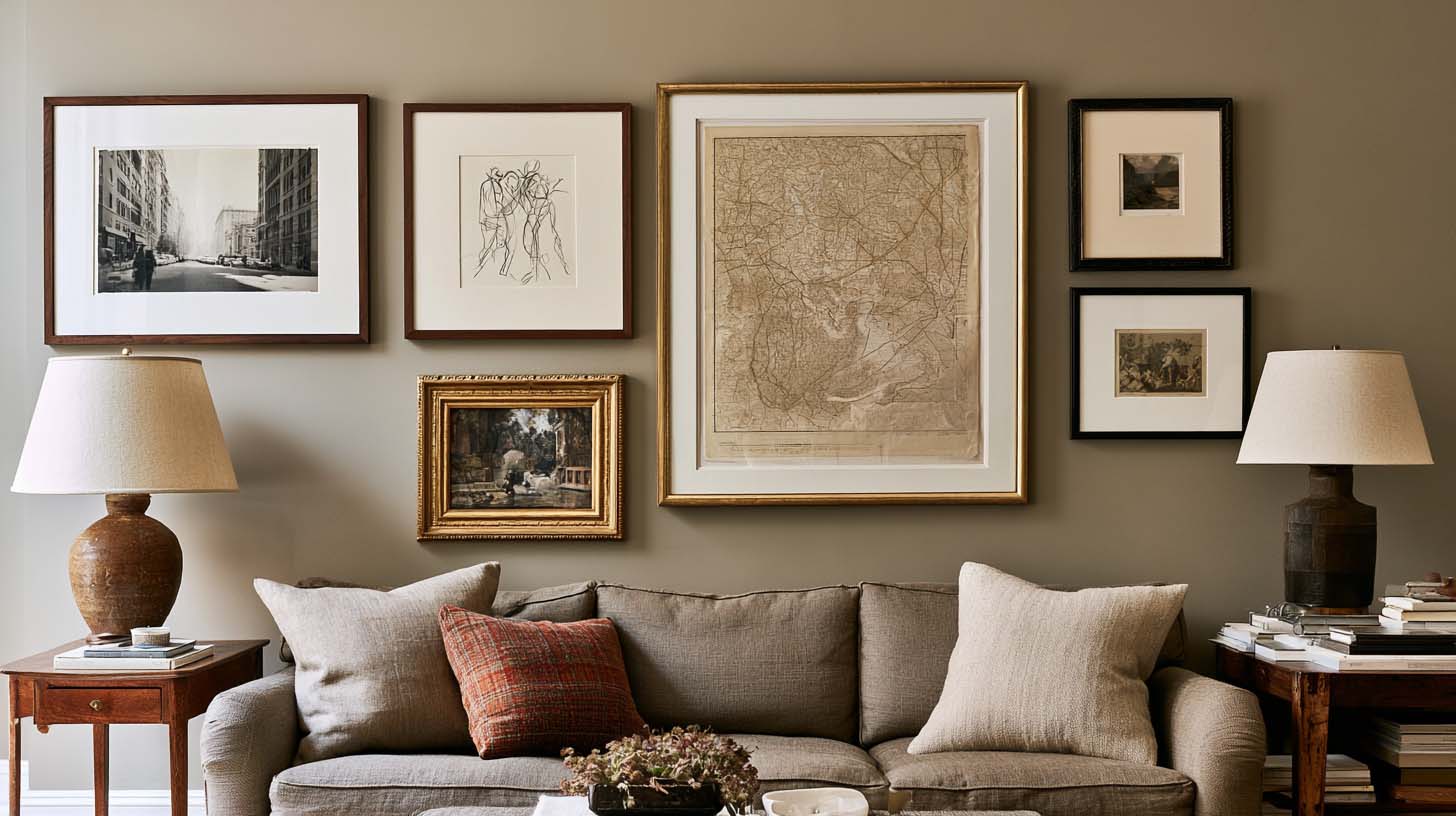
Avoid making every frame identical merely because uniform gallery walls are easy to organize. Consistency can help in a collection, but variety can make individual pieces feel more authentic. An old print in an old frame often looks better because the frame has become part of its history.
Stop Hanging Everything Too High
One of the most common artwork mistakes is simply hanging it too high. The eye should encounter art comfortably rather than having to look upward at it as though it were signage. The correct height changes depending on furniture, ceiling height, artwork size, and whether the piece is viewed while standing or sitting.
Artwork above a sofa must relate to the sofa. Artwork in a hallway relates more to standing eye level. A very large painting may naturally occupy more vertical space. The useful principle is connection. The artwork should look like it belongs to the furniture or architecture around it rather than floating independently above everything.
One Great Piece Can Be Better Than a Gallery Wall
Gallery walls are useful. They can also become a way of avoiding the difficulty of choosing something important. One large work produces confidence. It gives the room a focal point. The eye knows where to go. A gallery wall creates something different: rhythm, variety, accumulation, and narrative.
Choose according to the room. A modern living room with strong architecture may benefit from one substantial painting. A stair hall may suit a collection. A study might carry several small historic works. A bedroom may need only one quiet piece opposite the bed. More art does not make the room more cultured. Better relationships do.
Develop Taste by Looking Before Buying
The most effective way to improve your art choices may be to stop shopping for art for a while. Go look at it: museums, galleries, local exhibitions, art fairs, auction previews, estate sales, antique shops, university galleries, open studios, and online museum collections.
MoMA's collection alone spans painting, sculpture, drawing, photography, printmaking, architecture, design, film, and media, which is useful simply as a reminder of how narrow most retail wall art categories really are. (The Museum of Modern Art) Look widely. Notice patterns in your own response. That recurring attraction is the beginning of taste.
Buy Slowly
A home does not need all of its art immediately. In fact, one of the reasons generic wall decor proliferates is that homeowners feel pressure to fill empty walls quickly. Leave the wall blank. Wait. The right piece may appear six months from now.
You may discover it on a trip, at an estate sale, from a local artist, or at a gallery you had never visited. Collecting slowly creates the same advantage that antiques create elsewhere in the home. The pieces arrive from different moments and sources. The room develops biography.
Art Should Reveal the Man, Not Describe Him
There is a useful distinction between identity and biography. A sign that says whiskey describes an interest. An old photograph from a distillery you visited may carry biography. A generic vintage car poster describes an interest. A race photograph connected to an event you followed for years may carry biography. A world map describes travel. A map of somewhere meaningful to you carries biography. The more specific the object becomes, the less it needs to explain itself.
The TMH Perspective
In design projects, artwork is often treated as the last thing to be purchased. That is understandable, but not always ideal. Sometimes the strongest artwork should come earlier. A painting can establish the palette. A photograph can determine the mood. A collection can shape an entire wall. An old map may give an office its direction.
When art is good enough, it should not simply fit the design. The design should occasionally be willing to move around it. That is a more mature relationship with art than asking whether the frame matches the coffee table. If you know your rooms need better artwork but everything you find feels generic, TMH's Full-Service Interior Design can integrate art selection with scale, furniture, architecture, color, framing, and the broader identity of the room rather than treating the walls as an afterthought.
Frequently Asked Questions
Is it better to buy one large piece of art or several smaller ones?
It depends on the wall and the room. One substantial piece often gives a strong architectural room a clear focal point, while several smaller works can suit a stair hall or a wall meant to develop as a collection over time.
Do I need to buy original art, or are quality prints acceptable?
Quality editioned prints, etchings, lithographs, and photographs are legitimate original works within their edition, not mass reproductions. They can be an excellent, more affordable entry point into serious collecting.
How do I know if a piece of art is the right size for my wall?
Tape out the dimensions directly on the wall before buying, then stand back and view it from where you actually sit or enter the room. Most sizing mistakes become obvious once you see the taped outline in place.
Should artwork match the color palette of the room?
Not necessarily. Art chosen purely to match upholstery or wall color tends to feel disposable. Art chosen because it genuinely holds your attention usually integrates better over time, even without a perfect color match.

Facebook
Instagram
Youtube